Agentic AI vs Generative AI: Key Differences and When to Use Each
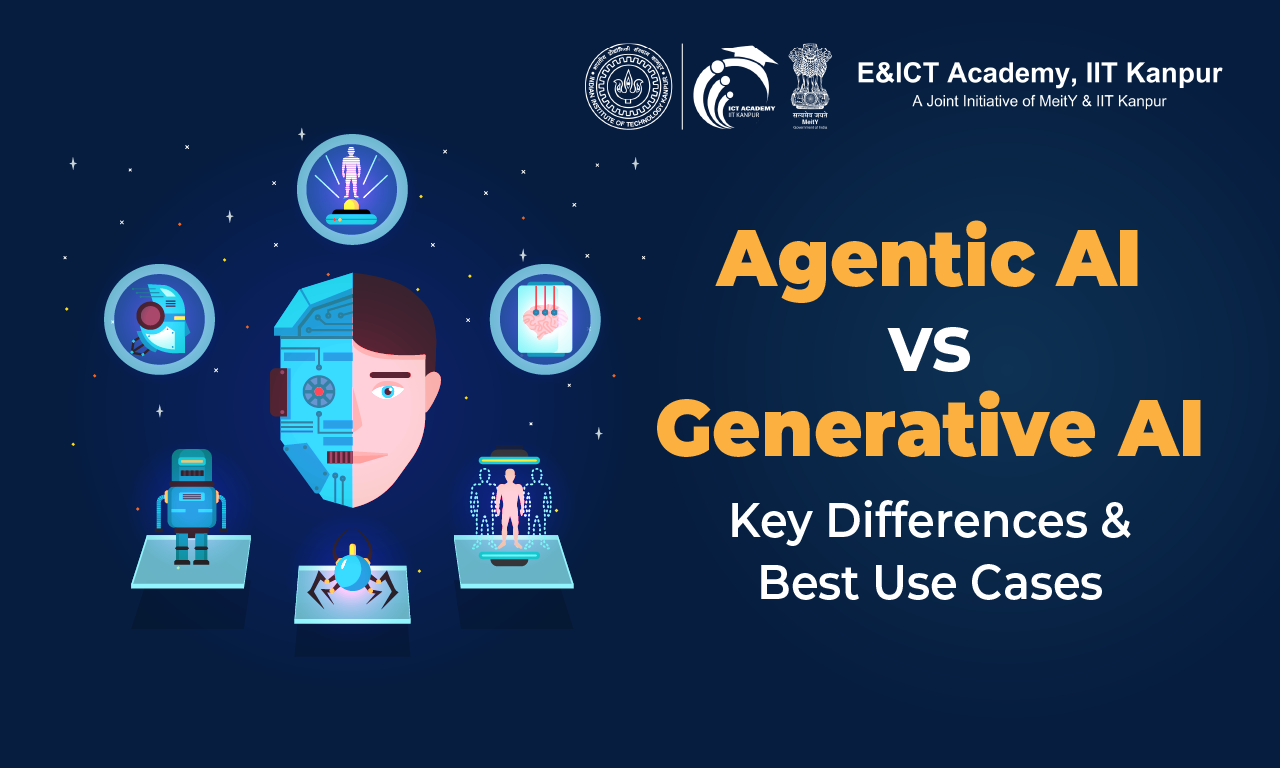
Generative AI creates content in response to a prompt. Agentic AI takes actions to accomplish a goal. Both run on the same underlying large language models, but they behave fundamentally differently. One produces output when you ask. The other pursues an outcome on its own.
Generative AI is like a highly capable assistant who writes whatever you request. Agentic AI is like a capable employee who receives a goal, plans how to achieve it, executes the steps, uses available tools, checks its own progress, and reports back when done.
Understanding this difference is one of the most practically useful things any business leader, product manager, or technology professional can learn about AI in 2026.
Agentic AI vs Generative AI: Core Comparison at a Glance
| Dimension | Generative AI | Agentic AI |
|---|---|---|
| Primary function | Creates content from a prompt | Completes tasks to achieve a goal |
| Interaction model | One prompt, one response | Perceives state, plans, acts, observes, repeats |
| Memory | None by default (stateless) | Maintains context across multiple steps |
| Tool use | None | Calls APIs, searches, reads files, executes code |
| Autonomy | Reactive (waits for instruction) | Proactive (pursues goal without per-step prompting) |
| Risk type | Informational (bad text a human reviews) | Operational (wrong actions on live systems) |
| Human oversight | Reviews output after generation | Required at key decision points before irreversible actions |
| Examples | ChatGPT, Claude, Gemini, Midjourney | AutoGPT, Devin, Claude Code (agentic mode), AI SDRs |
What Is Generative AI?
Generative AI is a class of artificial intelligence that produces new content, including text, images, code, audio, and video, in response to a prompt. It learns patterns from large datasets during training and uses those patterns to generate relevant outputs on demand.
The defining characteristic is that generative AI is reactive. It waits for a prompt, processes it, and returns a response. The interaction ends there. If you want it to do something else, you send another prompt. Each interaction is largely independent.
You have almost certainly used generative AI. ChatGPT, Claude, Gemini, GitHub Copilot, Midjourney, and Sora are all generative AI systems. When you ask ChatGPT to summarise a document, you are using generative AI. When you ask GitHub Copilot to suggest the next line of code, you are using generative AI.
What Generative AI Does Well
- Writing, editing, and rewriting text across any format and tone
- Generating images, illustrations, and visual concepts from text descriptions
- Writing and debugging code in response to specifications
- Summarising long documents into concise formats
- Translating content between languages
- Answering questions based on training knowledge or provided context
- Generating structured data from unstructured input
The Limitations That Define Generative AI's Boundaries
Generative AI does not take actions in the world. It cannot send an email, book a meeting, make an API call, update a database, or execute a process unless a separate system does that after reading its output. It also has no memory by default: each conversation starts fresh unless context is explicitly provided. And it produces one response per prompt, meaning multi-step tasks require a human to manage the sequence.
These limitations are not weaknesses of specific models. They are definitional characteristics of the architecture. Removing them is what agentic AI does.
What Is Agentic AI?
Agentic AI refers to AI systems that perceive a state, set goals, plan multi-step actions, call tools, observe the results of those actions, and update their plan accordingly, repeating this loop until the goal is achieved. The agent does not wait for a prompt at each step. It receives a goal and pursues it.
The fundamental architectural difference from generative AI is the agent loop. Where generative AI runs once per prompt, prompt in and content out, an agent runs a continuous perceive-plan-act-observe-reflect cycle until the task is complete or it determines the task cannot be completed.
An agentic AI system researching competitive intelligence, for example, does not just answer the question “what do our competitors do?” It searches the web for competitor websites, reads pricing pages, pulls recent news articles, analyses product documentation, synthesises findings across all sources, and produces a structured report, all without a human prompting each individual step.
The Components That Make an Agent Work
Goal or task definition: The agent receives a high-level objective rather than a specific instruction for each action.
Planning: The agent breaks the goal into a sequence of steps, determining what needs to happen first, second, and third to achieve the outcome.
Tool access: Agents call external tools including web search, file systems, databases, APIs, code execution environments, and communication systems to take real-world actions.
Memory: Agents maintain context across multiple steps and can store and retrieve information from previous actions in the current session or across sessions.
Observation and reflection: After each action, the agent observes the result and updates its plan. If a tool call fails or returns unexpected information, the agent adjusts rather than stopping.
Also read: How to Build an AI Agent From Scratch in 2026
What Agentic AI Does Well
- Completing multi-step workflows that require coordinating multiple tools and data sources
- Automating processes that previously required a human to manage each step
- Conducting research across multiple sources and synthesising a coherent output
- Writing, testing, debugging, and deploying code with minimal human intervention
- Managing calendars, emails, and scheduling across integrated systems
- Monitoring conditions and taking actions when defined triggers are met
The Seven Key Differences Between Generative AI and Agentic AI
1. Single-Turn vs Multi-Turn Execution
Generative AI completes one action per request. A prompt goes in, a response comes out, and the interaction is complete. If the task requires ten steps, a human must initiate ten separate prompts and manage the sequence between them.
Agentic AI runs a loop. One goal instruction triggers a sequence of actions that continues until the goal is achieved. The agent decides what to do at each step without requiring a human prompt between steps. A task that would require ten human-prompted generative AI interactions can be completed by an agent in a single instruction.
2. Reactive vs Proactive
Generative AI is purely reactive. It does nothing without a prompt. It has no awareness of state, no goals of its own, and no capacity to initiate action.
Agentic AI is proactive within the scope of its assigned goal. It identifies the next action required, executes it, evaluates the result, and determines the subsequent action without waiting for instruction. Some agents are also trigger-based: they monitor conditions and initiate action when those conditions are met, without any human prompt.
3. Stateless vs Stateful
Generative AI is stateless by default. Each conversation or API call begins without any memory of previous interactions. The only context available is what you include in the current prompt.
Agentic AI maintains state across the duration of a task. It remembers what it has already done, what it learned from previous steps, what failed and why, and what actions are still pending. Advanced agents can also maintain long-term memory across separate sessions, enabling them to build on previous work rather than starting from zero each time.
4. Content Output vs Action Output
The output of generative AI is content: text, images, code, audio. It produces something for a human to read, review, and act on. The human decides what to do with the output.
The output of agentic AI is actions taken in the world: files created, emails sent, APIs called, calendar entries booked, database records updated. The agent does not produce a draft for human review at each step. It acts, and the actions have real consequences.
This distinction explains why the risk profiles are fundamentally different. Generative AI introduces informational risk: the content might be wrong, biased, or misleading, but a human reviews it before it causes harm. Agentic AI introduces operational risk: the actions might be wrong, and they may have already affected live systems, customer data, or business processes before anyone reviews them.
5. No Tools vs Tool Use
Generative AI operates within its own knowledge and the content of the prompt. It cannot look anything up, call any external system, or access real-world data unless that data is provided in the prompt.
Agentic AI uses tools. A web search tool gives it access to current information. A file system tool lets it read and write documents. An API tool lets it interact with external services. A code execution tool lets it run and test programs. The tools available to an agent define what it can accomplish. The agent decides which tool to use at each step based on what the task requires.
6. Human in the Loop: Review vs Oversight
With generative AI, the human is at the end of every interaction: reviewing the output and deciding what to do with it. The human is the bridge between AI output and real-world action.
With agentic AI, the human is at the beginning of the task, setting the goal, and at defined oversight checkpoints, approving high-stakes actions before they execute. In between, the agent acts autonomously. This is why designing human-in-the-loop checkpoints for consequential actions is a non-negotiable requirement in production agentic AI systems. An agent that can send emails, update records, or execute financial transactions without any approval gate is an agent that can cause significant operational damage before anyone notices.
7. Informational Risk vs Operational Risk
Generative AI's failure mode is content quality: hallucinations, bias, inaccuracy, or inappropriate tone. These failures are serious but they are detectable at review before causing harm, and their consequences are bounded.
Agentic AI's failure mode is operational consequence: an agent that misunderstands a goal, misuses a tool, or encounters an unexpected state can take wrong actions on live systems. A customer support agent that processes refunds incorrectly at scale, a scheduling agent that books meetings with the wrong participants, or a code deployment agent that pushes breaking changes to production are examples of operational failures that are significantly harder to recover from than a hallucinated paragraph.
How Agentic AI and Generative AI Work Together
The relationship between the two is not competitive. It is architectural. Most agentic AI systems are built on top of generative AI models.
The agent uses an LLM to plan, deciding what to do next, to generate content, drafting the email it will send or writing the code it will test, and to reason about tool results, interpreting what a web search returned. The generative model is the cognitive engine inside the agent. The agent architecture is the operational layer that gives that engine the ability to act in the world.
When ChatGPT browses the web or executes Python, it is acting agentically for those steps. When a coding agent like Devin or Claude Code plans and edits code across an entire codebase, a generative model is making every individual decision. The two paradigms are layers in the same system, not alternatives.
FutureAGI's May 2026 analysis describes this precisely: “Generative AI is the layer that produces tokens, pixels, code, or audio in response to a prompt. Agentic AI is the layer that wraps a generative model in a loop that perceives state, decides, calls tools, and updates its plan. The difference is system design, not model class: the LLM makes the words, the agent makes the moves.”
The Autonomy Ladder: Choosing the Right Level
One of the most common and expensive mistakes in AI deployment is building a fully autonomous multi-agent system when a lower-autonomy solution would have solved the problem better, faster, and with significantly less risk.
The Autonomy Ladder from Uvik Software's 2026 framework describes five levels:
Level 1: Generative (reactive): A model that responds to prompts and produces content. No memory, no tools, no autonomy. Appropriate for content creation, answering questions, and generating first drafts.
Level 2: Retrieval-Augmented Generation (RAG) : A generative model connected to a knowledge source so it can answer questions grounded in specific documents or data. Appropriate for customer support Q&A, internal knowledge search, and document analysis where accuracy matters.
Level 3: Single-agent with tools: A single agent that can use a defined set of tools to complete a specific task. Appropriate for research workflows, data extraction, and process automation where the scope is well-defined.
Level 4: Multi-agent systems: Multiple specialised agents coordinated by an orchestrator. Appropriate for complex workflows that benefit from parallelisation or where different parts of a task require different specialisations.
Level 5: Autonomous agentic systems: Agents that operate in open-ended environments with broad tool access and minimal human intervention. Appropriate for very specific high-value use cases with extensive guardrails and oversight infrastructure.
The practical recommendation: choose the lowest autonomy level that genuinely solves the problem. Most real production wins come from Level 2 and Level 3 systems. Most production failures come from organisations attempting Level 4 and Level 5 before establishing the governance infrastructure those levels require.
When to Use Generative AI
Generative AI is the right choice when the task is well-scoped, the output is content rather than action, and a human will review the output before it has real-world consequences.
Use Generative AI For
Content creation at scale: Blog posts, marketing copy, email templates, social media content, product descriptions, and documentation that requires human review before publication.
Code assistance: Writing function implementations, suggesting completions, explaining existing code, generating tests for human review and execution, and drafting documentation.
Research synthesis: Summarising long documents, extracting key information from reports, translating content, and producing first-draft analyses that a human refines.
Customer-facing chat: Answering questions, providing information, handling simple support interactions where the output is text and a human can review escalated cases.
Creative work: Generating images, illustrations, and visual concepts, producing audio and video content, and ideating across creative formats.
Data analysis support: Generating SQL queries, explaining data patterns, and producing visualisation descriptions for human execution and validation.
When to Use Agentic AI
Agentic AI is the right choice when the task is multi-step, the required output is action rather than content, and the workflow currently requires a human to manage the sequence between steps.
Use Agentic AI For
End-to-end research: Competitive intelligence gathering, market research, due diligence, and any research task that requires querying multiple sources and synthesising across them.
Development automation: Writing, testing, debugging, and deploying code across an entire feature or codebase, with the agent managing the full development lifecycle rather than just generating individual code snippets.
Sales and outreach automation: AI Sales Development Representatives that research prospects, personalise outreach, send messages, track responses, and schedule meetings through integrated calendar and email tools.
Process automation: Workflows that currently require a human to pass outputs from one system to another, trigger actions based on conditions, or manage a sequence of steps across multiple tools.
IT operations: Monitoring system health, diagnosing incidents, applying known fixes, escalating novel issues, and generating incident reports without requiring human attention for routine events.
Data pipeline management: Extracting data from multiple sources, transforming it according to defined rules, loading it into target systems, and validating the results.
The Governance Requirement That Determines Success or Failure
McKinsey's State of AI Global Survey 2025 found that 62 percent of organisations are experimenting with agentic AI, but only 23 percent have scaled it into production. The gap is governance: knowing which AI system made a decision, what data it accessed, and who remains accountable when autonomous actions have real-world consequences.
Gartner projects that more than 40 percent of agentic AI projects will be cancelled by the end of 2027, citing escalating costs, unclear business value, and inadequate risk controls. The teams that succeed are not the ones that ship the fastest. They are the ones that scope autonomy correctly and design human oversight in from the first day.
Also read: Top Challenges in Artificial Intelligence in 2026
The governance requirements for production agentic AI differ fundamentally from those for generative AI:
Audit trails: Every action the agent takes must be logged with sufficient detail to reconstruct exactly what happened, in what order, using what data, with what result. This is necessary for debugging failures, satisfying regulatory requirements, and maintaining accountability when autonomous actions produce unintended outcomes.
Approval gates: Any action that is difficult or impossible to reverse, including sending communications, processing financial transactions, modifying production systems, and deleting data, requires a human approval step before the agent executes it. Autonomy is a dial turned up carefully, not a switch flipped to maximum.
Scope limitation: Agents should have access only to the tools and data required for the specific task assigned to them. Broad tool access increases the blast radius of any agent failure. A customer service agent should not have write access to the production database.
Failure recovery: What happens when an agent encounters an unexpected state, a tool call fails, or the task cannot be completed as scoped? Production agents need defined fallback behaviours, including when to escalate to a human rather than attempting to proceed.
Real-World Examples: Generative AI and Agentic AI in Practice
Example 1: Customer Support
Generative AI application: A chatbot that answers common product questions using a knowledge base, with responses reviewed against a quality rubric and escalated to humans for complex issues.
Agentic AI application: A support agent that reads the customer's complaint, checks the order system to understand what happened, determines whether a refund is warranted based on policy, processes the refund through the payment system, sends a personalised email confirmation, and updates the customer record, all without human involvement for qualifying cases.
Example 2: Software Development
Generative AI application: GitHub Copilot suggesting code completions and function implementations as a developer writes, with the developer reviewing each suggestion before accepting it.
Agentic AI application: Devin or Claude Code receiving a feature specification, planning the implementation, writing the code, running the test suite, identifying and fixing failing tests, and creating a pull request for human review, completing the full implementation cycle autonomously.
Example 3: Research and Intelligence
Generative AI application: A product manager pastes competitor pricing pages into Claude and asks for a summary and comparison.
Agentic AI application: A research agent that receives a request to analyse competitive positioning, searches for competitor websites, reads pricing and product pages, finds recent news articles about each competitor, checks review platforms for customer sentiment, and produces a structured competitive intelligence report with cited sources, all initiated by a single instruction.
Example 4: Indian Business Context
Generative AI application: A financial services firm uses Claude to generate personalised investment commentary for client reports, reviewed by an advisor before sending.
Agentic AI application: A compliance monitoring agent at a SEBI-regulated asset management company checks portfolio positions against regulatory limits daily, flags positions approaching threshold limits, drafts the required regulatory notifications, and queues them for compliance officer approval before submission.
Agentic AI vs Generative AI in India: The 2026 Landscape
India's technology sector is deploying both paradigms at scale, with specific applications shaped by the regulatory environment and the maturity of digital infrastructure.
Generative AI adoption is broad and accelerating. Indian software companies, IT services firms, and product companies are using generative AI for code generation, content creation, customer support text generation, and document processing. Infosys Topaz, TCS AI Cloud, and Wipro ai360 are all generative AI platforms built specifically for enterprise clients. Indian startups including Krutrim, Sarvam AI, and CoRover are building generative AI products for Indian language contexts.
Agentic AI adoption is narrower and more carefully governed. Indian financial services organisations including banks, NBFCs, and asset management companies are deploying agentic AI for compliance monitoring, KYC verification workflows, and fraud detection processes, but with significant human oversight provisions aligned with RBI and SEBI expectations for automated decision-making in regulated contexts.
Also read: AI in Fintech: Applications, Companies and Use Cases 2026
The DPDP Act 2023 creates specific governance requirements for both paradigms. Agentic AI systems that process personal data autonomously need explicit consent and data handling assessments that go beyond what generative AI content generation requires, because agents take actions with that data rather than simply generating text about it.
Related AI Articles
Frequently Asked Questions
What is the difference between generative AI and agentic AI?
Generative AI creates content in response to a prompt and stops. Agentic AI pursues a goal by planning a sequence of steps, using tools to take real-world actions, observing results, and updating its plan until the goal is achieved. The core distinction is that generative AI produces content for a human to act on, while agentic AI acts itself. Both run on large language models, but agentic AI wraps the language model in an operational loop that gives it the ability to use tools, maintain memory across steps, and take actions in connected systems without per-step human instruction.
Is ChatGPT generative AI or agentic AI?
ChatGPT is primarily a generative AI system in its standard conversational mode. When ChatGPT uses tools such as web search, Python code execution, or file reading, it is behaving agentically for those specific steps. This is why the boundary between the two paradigms is blurring in 2026: most capable AI products incorporate agentic capabilities alongside generative ones. The base model is generative. The tool use and multi-step execution that wraps it is agentic.
Which is more dangerous: generative AI or agentic AI?
They carry different risk types rather than different risk magnitudes. Generative AI introduces informational risk: the output might be inaccurate, biased, or misleading, but a human reviews it before it has consequences in the world. Agentic AI introduces operational risk: wrong actions on live systems can affect customers, data, and business processes before anyone reviews them. Agentic AI requires significantly more governance investment, including audit trails, approval gates for irreversible actions, and scope limitation, precisely because its failure modes have immediate operational consequences rather than informational ones that can be caught at review.
When should a business use agentic AI instead of generative AI?
Use agentic AI when the task is multi-step, when the required output is an action rather than content, and when a human currently manages the sequence between steps in a workflow that does not benefit from that human involvement. If a task requires querying multiple sources, calling multiple systems, or executing a process across several tools, agentic AI is appropriate. If the task is well-scoped, the output is content that a human reviews, and each step benefits from human judgment, generative AI is more appropriate. For most organisations in 2026, the right answer is both, in different parts of the workflow, with agentic AI handling execution and generative AI handling content generation within those workflows.
Why are only 23 percent of organisations scaling agentic AI to production?
McKinsey's State of AI Global Survey 2025 found that while 62 percent of organisations are experimenting with agentic AI, only 23 percent have scaled it into production. The gap is governance infrastructure: production agentic AI requires audit trails, approval gates for consequential actions, scope-limited tool access, failure recovery protocols, and observability into what the agent did and why. These requirements are significantly more demanding than what generative AI content generation requires. Organisations that skip governance during the pilot phase discover the requirement when they attempt to scale, at which point retrofitting it into an existing system is far more expensive than building it in from the start.
What is a multi-agent system and when is it appropriate?
A multi-agent system coordinates multiple specialised AI agents, typically with an orchestrator agent that plans and delegates to worker agents that specialise in specific tasks. A supervisor-worker architecture is the most common: one agent plans and delegates, others specialise in research, writing, coding, or other specific functions. Multi-agent systems are appropriate when a complex workflow benefits from parallelisation or when different parts of a task require genuinely different specialisations. However, most organisations should master single-agent, well-scoped deployments before attempting multi-agent systems. Gartner projects that more than 40 percent of agentic AI projects will be cancelled by end of 2027 due to escalating costs and inadequate risk controls, and multi-agent complexity is a significant contributor to those failures.