AI in Healthcare: Meaning, Applications, Benefits, Challenges, and Future Trends
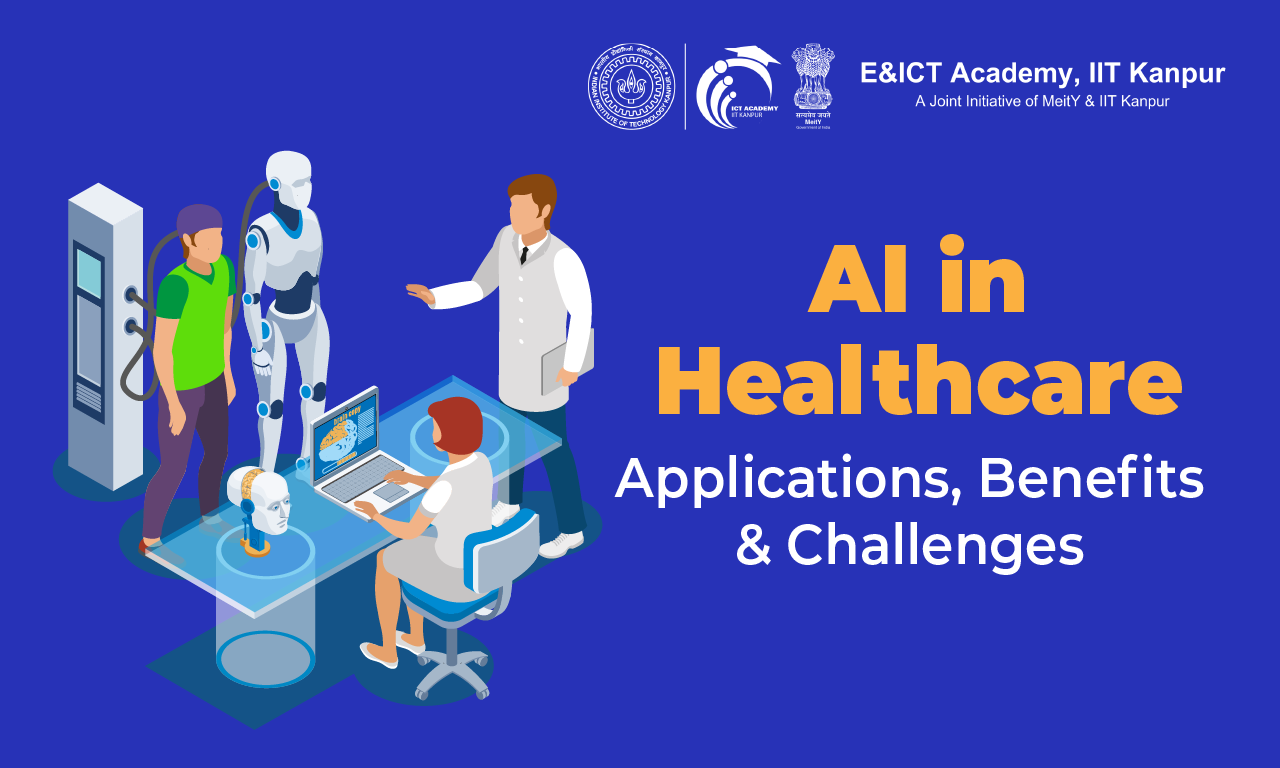
Have you ever sat in a waiting room and wondered how your experience might be different if hospitals offered individualized treatment plans, diagnosed patients more quickly, or used more advanced technology? The core of AI in healthcare is that question. The idea is simple. Similar to having an additional pair of hands, machines assist doctors, nurses, and patients by learning from medical data.
This article walks you through what AI in healthcare means, where it shows up, and why so many people feel hopeful about its direction. You’ll also find gentle guidance, real examples, and resources from EICTA Consortium, such as their course in GenAI & Machine Learning, which offers simple explanations without demanding a heavy technical background.
AI in Healthcare Course: Enroll Today!
Understanding the Role of AI in Modern Healthcare
In the healthcare setting, artificial intelligence (AI) refers to computer algorithms that can spot patterns, evaluate medical data, and assist medical workers in making better decisions. Consider it a tireless helper who never tires, monitors billions of data points, and assists in high-stress situations where every second matters.
If you want a basic understanding, you can refer to introductory data science or analytics resources, such as the workshops shared by EICTA, since AI applies these same principles in medical settings.
How AI Shows Up in Real Medical Settings
This is the problem. Artificial intelligence is no longer limited to academic papers. Hospitals, laboratories, and patient portals already have it. Some of these tools communicate directly with clinicians, while others remain silent in the background. You can check out this course from EICTA Consortium, and it will help you understand Artificial Intelligence. It is a hybrid course, and you’ll receive a winter training certificate after completion of the course.
1. Diagnostic Support
- AI models can examine MRIs, CT images, and X-rays to detect probable problem areas.
- During a long shift, they frequently pick up on tiny patterns that the human eye could overlook.
- Doctors are not replaced by this. Rather, it provides them with an additional viewpoint, akin to quickly
obtaining a second opinion.
2. Predictive Analysis
Have you ever wished someone could alert you before a significant issue arises? To accomplish this, AI systems analyze lab data, treatment patterns, lifestyle factors, and patient histories. They raise awareness about the risk of diseases such as infections, diabetes, and heart failure before they deteriorate.
3. Personalized Treatment Plans
While one patient responds well to a medicine, another suffers negative consequences. AI can help clinicians provide individualized therapeutic suggestions by comparing hundreds of similar cases. Patients who have tried several therapies without success typically feel more at peace after this slight change.
4. Operational Support
Long lines and scheduling problems are common problems at hospitals. AI facilitates workflow optimization, bed availability management, and peak hour prediction. An acquaintance once told me how badly handled schedules caused her father's surgery to be postponed for many hours. These types of tools are designed to alleviate circumstances like that.
5. Virtual Health Assistants
These are basic apps or chatbots that help people schedule follow-up appointments, track symptoms, and remember medicines. They aren't fancy, but they make individuals feel more supported at home and less likely to forget things.
Why AI in Healthcare is Vital: Benefits That Touch Real Lives
Since the impact frequently seems abstract until you visualize it in everyday situations, let's break this down slowly.
Faster and more reliable diagnosis
Quicker alleviation is frequently the result of a quicker diagnosis. The time between examination and treatment is reduced when radiologists or physicians are assisted by AI.
More accurate predictions
Patients can adapt earlier when physicians can predict dangers. This can improve long-term health while reducing the number of ER visits.
Better patient experience
The entire course of a patient's therapy can be altered by minor changes like shorter wait times or prompt medication reminders.
Support for overwhelmed healthcare workers
A lot of hospitals have few employees. AI reduces some of the workload, allowing clinicians to focus on human encounters rather than administrative tasks.
The Challenges of AI in Healthcare That We Can’t Ignore
Progress, of course, comes with challenges. Recognizing them also strengthens the field.
1. Data Privacy and Security
Medical records are private. They must be properly protected by any AI system that makes use of them. Patients must have the assurance that their information is not being used in a hazardous manner.
2. Bias in Medical Data
A system's output exhibits the same fault if it learns on skewed or incomplete input. This may result in different diagnosis accuracy for different demographic groups. The medical community is actively discussing how to correct this, which is encouraging.
3. Cost of Implementation
Because AI tools need funding, continuous support, and training, smaller hospitals may hesitate. It is hoped that these expenses will decrease as tools advance.
4. Acceptance among clinicians
Some medical experts are afraid that AI may hamper their ability to make clinical decisions. Some people welcome it. As tools become more transparent over time, more professionals feel at ease utilizing them as collaborators rather than substitutes.
| Related Articles | |
|---|---|
| Conversational AI in Healthcare | Agentic AI Frameworks |
| AI in Healthcare Examples | The Role of AI in Healthcare |
| The Future of AI in Healthcare | How AI Is Used in Healthcare |
Future Trends of AI in Healthcare
The future appears to be a series of modest steps that add up rather than a single large leap.
1. More collaboration between humans and machines
AI software and doctors will probably collaborate. While people provide intuition, empathy, and reasoning, machines undertake repeated analysis.
2. Greater use of wearable devices
Smartwatches are already widely used to track heart rate and steps. These gadgets may soon be able to identify irregular sleep patterns, glucose patterns, or rhythms early enough to initiate rapid medical attention.
3. Growth in AI-guided drug discovery
Research on drugs frequently takes years. Large chemical compound libraries may be swiftly screened by AI techniques, which can also direct researchers toward viable solutions.
4. AI in mental health support
More digital tools for therapy, early emotional distress detection, and helpful check-ins may become apparent. These are small bridges throughout trying periods, not human therapists' substitutes.
Traditional vs AI-Aided Healthcare
|
Aspect |
Traditional Approach |
AI-Enabled Approach |
|
Diagnosis time |
Can be slow during high patient load |
Often quicker through automated analysis |
|
Predicting risk |
Relies heavily on clinician experience |
Studies large data trends to suggest risks |
|
Treatment planning |
Largely manual research |
Compares patterns across many cases |
|
Patient engagement |
Appointments and phone calls |
Apps, reminders, virtual assistants |
Conclusion
AI in healthcare isn't a pipe dream. It is already sneaking into homes, labs, and clinics. It is not necessary to be a technical specialist to appreciate its direction. The most crucial aspect is how these technologies enable patients who are often overworked to feel less stressed, make better decisions, and gain clarity.
AI cannot take the place of a doctor's comforting words or a nurse at a patient's bedside. Nonetheless, it can assist them in ways that are advantageous to all hospital visitors. And that alone makes the trip worthwhile.
Frequently Asked Questions (FAQs)
1. What does AI in healthcare mean?
AI in healthcare means using artificial intelligence technologies such as machine learning, natural language processing, and predictive analytics to support medical tasks and healthcare decision-making. It helps healthcare systems process large amounts of data and improve the speed and accuracy of diagnosis, treatment, and patient care.
2. How is AI used in healthcare?
AI is used in healthcare for applications such as medical imaging analysis, disease prediction, virtual health assistants, personalized treatment recommendations, drug discovery, and hospital workflow automation. These uses help medical professionals work more efficiently and support better patient outcomes.
3. What are the benefits of AI in healthcare?
The main benefits of AI in healthcare include faster diagnosis, improved accuracy, personalized care, reduced administrative burden, and better use of healthcare resources. AI can also help identify patterns in patient data that may be difficult for humans to detect quickly.
4. Can AI replace doctors in healthcare?
AI is not designed to fully replace doctors but to assist them in making better-informed decisions. Human expertise, clinical judgment, empathy, and patient communication remain essential parts of healthcare that AI cannot fully replicate.
5. What are the challenges of using AI in healthcare?
Some major challenges include data privacy concerns, bias in AI models, regulatory compliance, integration with existing healthcare systems, and the need for high-quality medical data. Addressing these issues is important to ensure that AI is safe, fair, and effective in real-world healthcare settings.