Edge AI and IoT: How AI Is Moving to the Network Edge in 2026
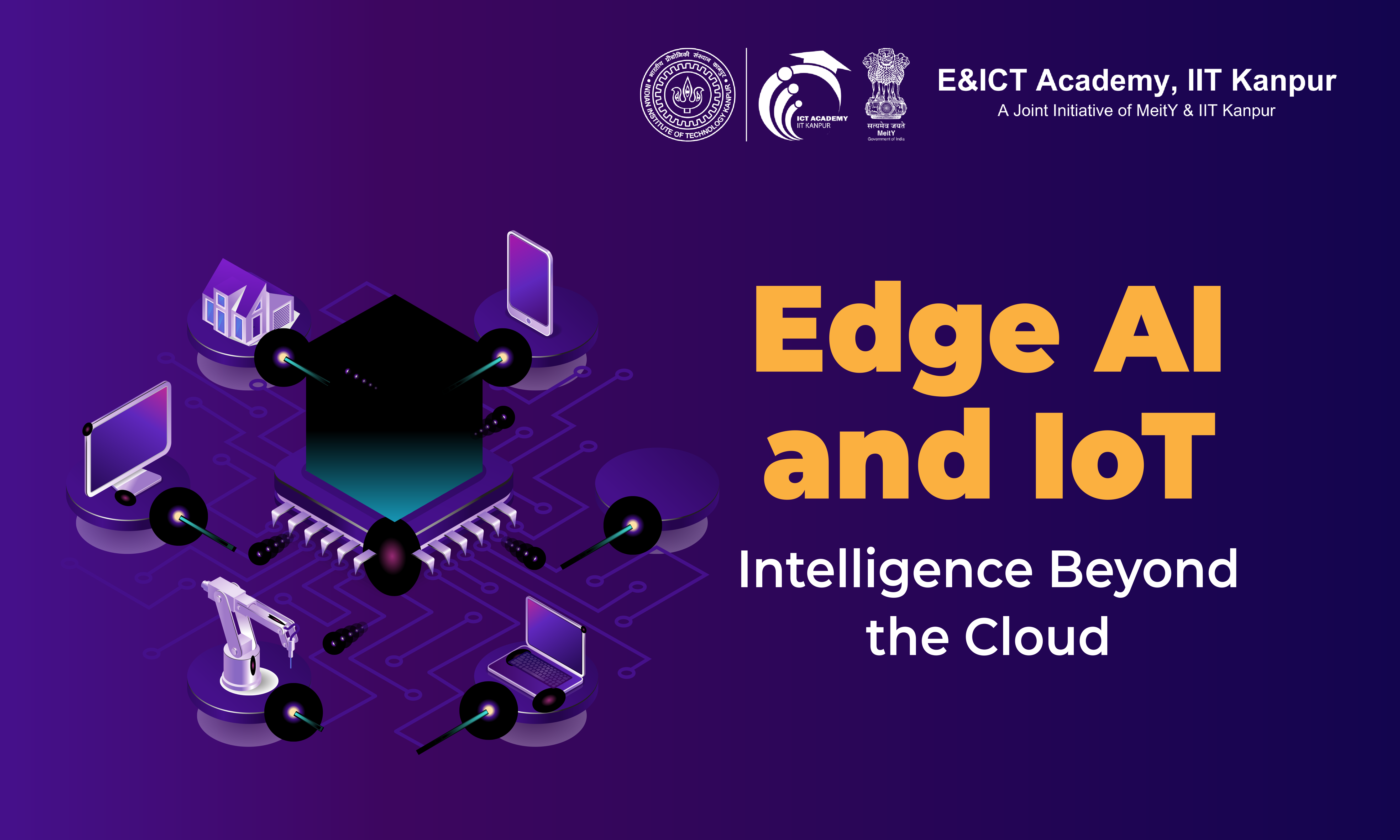
For most of the history of IoT, devices had one job: collect data and send it somewhere else to be processed. A sensor on a factory floor would ping a cloud server. A smart camera would upload footage and wait for analysis. The device itself was just a messenger.
That model worked until cloud costs climbed, data privacy regulations tightened, and engineers started asking why a machine should need a stable internet connection simply to detect that something is wrong.
The Edge AI market is valued at $14.8 billion and is projected to reach $163 billion by 2033, driven by the demand for instant analytics, advancements in AI hardware, and the rollout of 5G networks. Organisations deploying edge AI are achieving an average 80 percent reduction in data backhaul costs by filtering noise at the source and transmitting only actionable intelligence.
Best GenAI & Machine Learning Course - Enroll Now!
What edge AI changes about IoT architecture:
- Devices make decisions locally rather than waiting for cloud round-trips
- Sensitive data stays on-site rather than traversing networks to remote servers
- Systems continue operating during connectivity loss rather than failing completely
- Response times drop from hundreds of milliseconds to single-digit milliseconds
- Data transmission costs fall because insights are sent rather than raw streams
What Is Edge AI?
Edge AI is the deployment of artificial intelligence algorithms directly on edge devices or local infrastructure, enabling data processing and decision-making at the point where data is generated, without relying on cloud connectivity for inference.
The devices running edge AI include microcontrollers inside industrial robots, chips inside hospital-grade wearables, processors inside traffic cameras, and neural engines inside smartphones. The intelligence lives where the data lives.
A smart security camera illustrates the difference clearly. The traditional approach: stream video to the cloud, have a server analyse it, and receive an alert after the round-trip. The edge approach: a computer vision model running directly on the camera identifies an anomaly in under a second, with no upload, no waiting, and no footage leaving the building.
Edge AI enables real-time decision-making in environments where cloud connectivity is limited or unreliable. Key technologies include embedded AI chips, lightweight machine learning models, and edge computing platforms. Use cases span industrial automation, smart cities, healthcare, logistics, and energy management.
Must Read: Agentic AI Use Cases
Why AI Is Moving to the Network Edge in 2026
Three developments converged to make edge AI viable at scale in 2026.
Hardware finally caught up. Neural Processing Units (NPUs), purpose-built AI chips, have become cheap and power-efficient enough to sit inside everyday devices. NVIDIA's Jetson series brings serious inference capability to robotics, autonomous vehicles, and industrial inspection cameras. Google's Edge TPU provides efficient on-device machine learning specifically designed for power-constrained IoT applications. MediaTek's Genio series, along with offerings from Qualcomm and NXP, are putting AI inference capability into industrial sensors and medical monitors without draining a battery in hours.
At Embedded World 2026, chipmakers including Ambarella demonstrated the next generation of edge AI hardware, pushing more AI processing directly onto camera chips and moving into the broader industrial edge computing market. This shift from dedicated edge AI hardware to AI-embedded general IoT chips represents the point where edge AI stops being a specialist choice and becomes the default architecture.
Models got small enough to fit. Techniques including quantisation (reducing the numerical precision of model weights) and pruning (removing redundant model components) allow engineers to shrink AI models dramatically without gutting their accuracy. A model that once required a data centre GPU can now run on hardware with a few megabytes of memory. Platform tools like TensorFlow Lite, PyTorch Mobile, and AWS Greengrass provide the deployment infrastructure to run optimised models on resource-constrained edge hardware reliably.
External pressure became concrete. The EU AI Act became enforceable in 2026, with specific requirements for AI systems deployed in regulated industries including healthcare and critical infrastructure. Cloud costs are climbing as IoT device counts grow. 5G is making edge connectivity more dependable and low-latency. And engineers managing IoT deployments at scale are increasingly unwilling to build architectures that fail every time connectivity drops.
Edge AI vs Cloud AI: When Each Approach Makes Sense
Both approaches are valid. The question is which fits your specific deployment constraints.
| Factor | Edge AI | Cloud AI |
|---|---|---|
| Latency | Near-zero, milliseconds | Higher, round-trip delay |
| Bandwidth | Minimal, data stays local | High, raw data streams transmitted |
| Privacy | Data processed on-device | Data transmitted to remote servers |
| Offline operation | Fully functional | Requires connectivity |
| Cost model | Lower bandwidth and cloud spend | Ongoing cloud compute costs |
| Best for | Real-time decisions, privacy-sensitive data | Model training, complex analytics, large datasets |
Cloud AI retains a strong case for training new models, running complex analytics across large historical datasets, or any application where a few hundred milliseconds of latency does not affect outcomes. For IoT systems where a device must act immediately, not just report, the edge is increasingly the right architecture.
In practice, most production deployments use a hybrid approach: edge devices handle time-sensitive inference and local control, while cloud systems handle model training, fleet-wide performance monitoring, and complex analytics that benefit from aggregated data.
Also Read: AI Programming Languages: Python, R and What to Learn for AI
Edge AI and IoT Use Cases Across Industries
Manufacturing: Predictive Maintenance and Quality Inspection
By running AI models directly on edge gateways, manufacturers can perform real-time visual quality inspections on high-speed production lines. By analysing high-frequency vibration data from critical motors, the system enables predictive maintenance, detecting mechanical anomalies weeks before a catastrophic failure, without clogging the cloud with raw sensor noise.
On assembly lines, edge-enabled cameras inspect components at production speed and reject defective parts without slowing the line. When something drifts outside normal operating range, the system flags the deviation immediately. The uptime gains and scrap reductions are measurable within weeks of deployment.
The economics are direct. Unplanned downtime in manufacturing can cost tens of thousands of dollars per hour. A predictive maintenance system that provides 72 hours of advance warning of a bearing failure allows the maintenance team to schedule the repair during planned downtime rather than responding to an emergency.
Healthcare: AI That Goes Where the Patient Is
Wearable medical devices are running ECG analysis, blood oxygen monitoring, fall detection, and gait assessment locally, on the device. This matters for two reasons: speed and privacy.
Speed, because a cardiac irregularity detected in real time on the wearable can trigger an immediate alert, while the same detection through a cloud round-trip introduces delay that may matter clinically. Privacy, because medical data processed and retained on the device does not traverse networks to remote servers, which directly supports compliance with healthcare data regulations.
Hospitals are also deploying edge AI in imaging equipment, enabling preliminary analysis of X-rays and scans at the point of capture without transmitting full imaging files to centralised diagnostic systems for every routine reading.
Read More: How AI Is Used in Healthcare: Practical Examples and Technologies
Autonomous Vehicles: When the Cloud Is Too Slow
A self-driving vehicle making an emergency braking decision has approximately 100 milliseconds to act. That window does not accommodate a cloud round-trip. Every perception, object classification, and response decision happens on hardware inside the vehicle.
Network edge processing in autonomous vehicles is not a design preference. It is a safety requirement built into the architecture from the ground up. NVIDIA's Jetson AGX platform is one of the primary compute platforms for autonomous vehicle edge inference, running real-time sensor fusion and decision-making at the vehicle level.
Smart Cities: Intelligence at the Intersection
City traffic management systems are using edge-processed video to adjust signal timing dynamically based on live vehicle density. Rather than streaming all camera footage to a central server for analysis, each camera processes its own video locally and sends only the traffic count and density signal upstream.
This architecture reduces infrastructure cost, eliminates the privacy risk of centralised video repositories, and makes the system resilient to connectivity loss. Individual intersections continue operating even when network connectivity to the central system is disrupted.
Retail applications use similar on-site inference for cashierless checkout systems. Computer vision models running on hardware inside the store track what customers select and process payment as they leave. The intelligence is on-site, not dependent on a consistent connection.
Leading Edge AI Hardware Platforms in 2026
NVIDIA Jetson: The dominant platform for high-performance edge AI inference. The Jetson AGX series targets autonomous vehicles and robotics. The Jetson Orin Nano targets smart cameras and industrial inspection. Power range of 5 to 30 watts depending on configuration.
Google Edge TPU: Designed specifically for running TensorFlow Lite models efficiently on power-constrained devices. Commonly deployed in smart cameras, industrial sensors, and retail automation. Optimised for high inference speed at low power.
Qualcomm AI Stack for IoT: Qualcomm's Snapdragon and QCS series integrate NPU capability into connected devices. Widely deployed in smart home devices, cameras, and industrial equipment.
AWS Greengrass: Software infrastructure for deploying, managing, and updating AI models on edge devices. Allows organisations to run Lambda functions and machine learning inference at the edge with cloud-based management.
Azure IoT Edge: Microsoft's platform for deploying containerised AI models and analytics workloads to edge devices, with cloud-based monitoring and management.
Benefits of Edge AI for IoT Deployments
Lower latency: Inference happens on the device, so the response is immediate. No data leaves the device before a decision is made. This is the non-negotiable requirement for autonomous vehicles, industrial safety systems, and real-time quality inspection.
Privacy by design: Sensitive information including medical readings, security footage, and financial behaviour stays on-site unless there is a deliberate decision to transmit it. This architecture directly supports GDPR, HIPAA, and India's DPDP Act compliance.
Lower bandwidth and cloud costs: Organisations transmit insights rather than raw data streams. This produces an average 80 percent reduction in data backhaul costs by filtering noise at the source.
Operational resilience: Edge devices continue functioning during network outages. For manufacturing, logistics, and healthcare applications where continuous operation is critical, this resilience is a significant architectural advantage over cloud-dependent systems.
Energy efficiency: Dedicated NPU hardware handles AI inference at a fraction of the energy that equivalent cloud-compute would consume. This enables deployment in battery-powered and energy-harvesting scenarios.
Challenges Worth Taking Seriously
Edge AI solves genuine problems and creates new ones. Organizations planning deployments should account for both.
Physical security: A cloud server sits in a locked data centre. An edge device sits on a factory floor, a street corner, or inside medical equipment. Physical access to the device can mean access to the model, the data it processes, or the broader network it connects to. Edge deployments require physical security planning that cloud deployments do not.
Fleet management complexity: Managing hundreds or thousands of edge devices, pushing firmware updates, refreshing models, monitoring device health, requires operational infrastructure that managing equivalent cloud workloads does not. Edge AI software infrastructure must enable deployment, management, monitoring, and updating of AI models on edge devices as an integrated system. Tools including KubeEdge and AWS Greengrass address this, but the operational complexity is genuinely higher than centralised cloud management.
Hardware constraints: Edge devices have limited processing power and memory compared to cloud systems. Running large models at the edge requires model optimisation through quantisation and pruning. Not all AI workloads are suitable for edge deployment in their original form.
Governance and regulatory compliance: The EU AI Act requires documentation of what AI systems do, how they were validated, and where they sit in the risk classification framework. For edge AI systems in healthcare, autonomous vehicles, or critical infrastructure, this governance work is substantial and ongoing.
Edge AI in India: The Specific Opportunity
India's industrial and infrastructure context creates specific opportunities for edge AI adoption that are distinct from Western markets.
Manufacturing under the PLI (Production Linked Incentive) scheme is driving large-scale investment in electronics, pharmaceuticals, and automotive components manufacturing. These facilities require quality inspection, predictive maintenance, and process optimization capabilities that edge AI provides. Indian manufacturers building these operations now have the opportunity to embed edge AI from the start, which is significantly more cost-effective than retrofitting it into established production lines.
Smart city programmes across Indian metros including Delhi, Mumbai, Pune, and Hyderabad are deploying IoT infrastructure for traffic management, air quality monitoring, and public safety. Edge processing reduces the bandwidth requirements that would otherwise make city-scale IoT deployment prohibitively expensive, and local data processing addresses the data sovereignty concerns that centralised cloud architectures create.
Healthcare applications are particularly significant in India, where the density of medical specialists in Tier 2 and Tier 3 cities is significantly lower than in metros. AI-powered diagnostic support running on edge hardware in district hospitals and rural health centres can extend access to preliminary diagnostic capability without requiring continuous cloud connectivity or centralised data transmission.
What Comes Next
2026 is an inflection point in edge AI, not an endpoint.
Emerging trends include the integration of Edge AI with 5G and upcoming 6G networks, enabling ultra-low latency and enhanced connectivity. Federated learning is gaining attention as a way to train models across distributed devices without sharing raw data. The convergence of edge and cloud platforms is leading to more unified development environments and orchestration tools, simplifying deployment and management.
6G, still several years from wide deployment, is being designed with AI inference capability built into the network infrastructure itself, not just at its endpoints. This means AI processing will eventually happen inside the communication network, enabling use cases that are not currently feasible even with dedicated edge hardware.
Agentic AI is beginning to appear at the edge: systems that do not just classify or detect anomalies, but reason across multiple inputs and take autonomous action without waiting for human instruction. A manufacturing edge system that detects an anomaly, consults its maintenance knowledge base, schedules a technician, orders the required part, and adjusts the production schedule around the planned maintenance window is a qualitatively different capability from one that only generates an alert.
Frequently Asked Questions
What is Edge AI and how does it differ from cloud AI?
Edge AI is the deployment of AI models directly on devices or local infrastructure, enabling inference to happen where data is generated without sending that data to a remote cloud server. Cloud AI processes data on centralized remote servers after it has been transmitted over a network. The practical difference is latency (milliseconds at the edge versus hundreds of milliseconds with cloud round-trip), privacy (data stays local versus being transmitted), and resilience (edge continues operating offline while cloud-dependent systems stop when connectivity drops).
What hardware is used for edge AI in IoT?
The leading hardware platforms are NVIDIA's Jetson series for high-performance applications including autonomous vehicles and industrial inspection, Google's Edge TPU for power-constrained IoT devices, Qualcomm's Snapdragon and QCS series for consumer and industrial connected devices, and MediaTek's Genio series for industrial sensors and monitors. For software deployment and management, AWS Greengrass and Azure IoT Edge are the most widely deployed platforms.
What are the main use cases for edge AI in IoT?
The highest-impact applications are predictive maintenance in manufacturing (detecting equipment anomalies before failures occur), quality inspection on production lines, real-time inference in autonomous vehicles and robotics where cloud latency is not acceptable, wearable medical devices running health monitoring locally for privacy and speed, smart city traffic management using on-site video analysis, and retail automation including cashierless checkout systems.
What are the challenges of deploying edge AI?
The primary challenges are physical security of devices deployed in accessible locations, fleet management complexity for large numbers of distributed devices requiring model updates and health monitoring, hardware constraints that require model optimization to run AI inference on limited compute resources, and regulatory compliance requirements under frameworks like the EU AI Act that mandate documentation and governance of edge AI systems.
Why is edge AI growing in 2026 specifically?
Three developments converged: edge AI hardware including NPUs has become cheap and power-efficient enough for mainstream IoT devices, model compression techniques like quantization and pruning have made it possible to run capable AI models on hardware with limited memory, and external pressure from privacy regulations, rising cloud costs, and the demand for offline operation resilience has made the cloud-only IoT architecture increasingly difficult to justify for latency-sensitive applications.