CEO vs CTO: Roles, Power Dynamics & How Both Shape Company Strategy
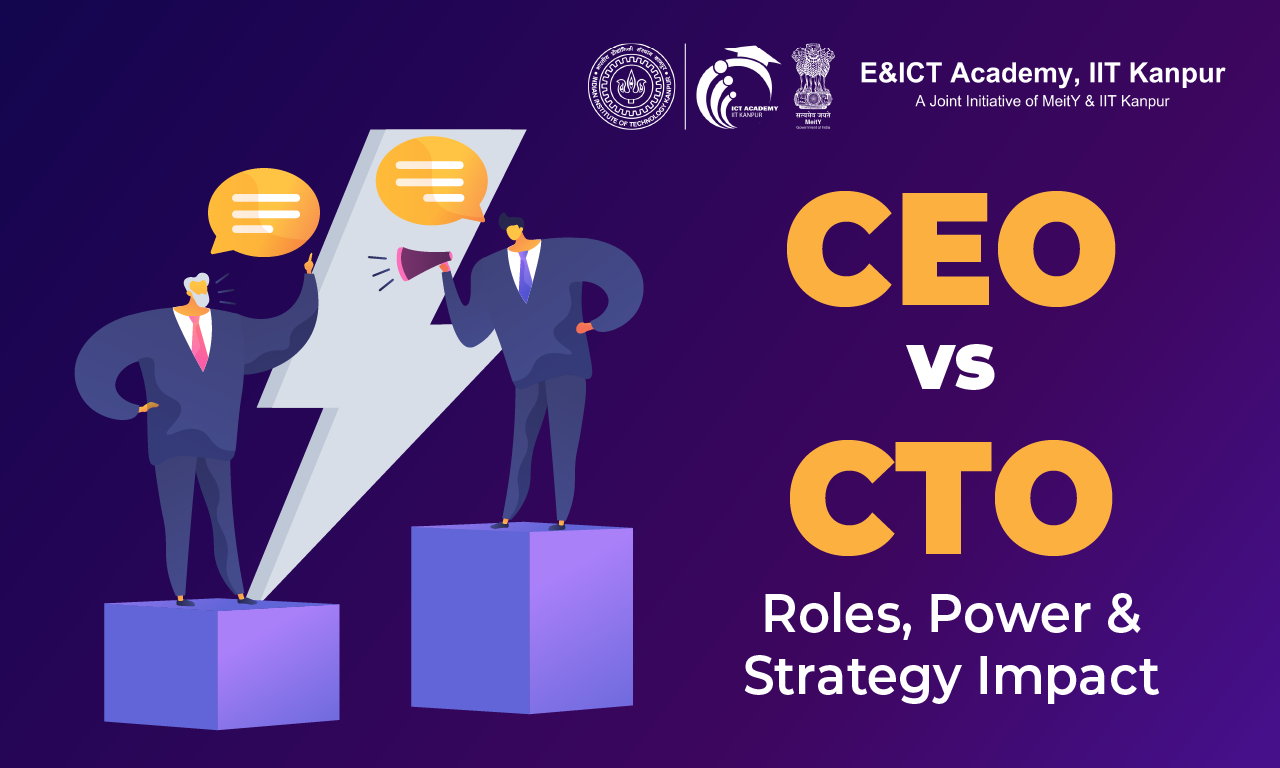
In today's technology-driven business environment, few leadership relationships are as critical or as misunderstood as CEO vs CTO. While both roles sit at the top of the organizational hierarchy, their responsibilities, authority, and influence on company strategy differ significantly. Yet, when aligned well, the CEO and CTO together become one of the most powerful forces behind sustainable growth, innovation, and competitive advantage.
This article breaks down the roles, power dynamics, strategic influence, and collaboration models between the CEO and CTO, offering a clear, modern perspective relevant for startups, scale-ups, and large enterprises alike.
Best CTO Online Course in India: Enroll Now!
Understanding the CEO Role in Modern Organizations
The Chief Executive Officer (CEO) is the highest-ranking executive, accountable for the overall success or failure of the organization. The CEO's authority spans across business units, functions, and long-term direction.
Core Responsibilities of a CEO
A CEO's role is broad and externally as well as internally focused:
- Defining the company's vision, mission, and long-term strategy
- Making final decisions on major investments, acquisitions, and market entry
- Managing relationships with the board, investors, regulators, and key partners
- Setting organizational culture and leadership tone
- Ensuring financial performance, growth, and risk management
In the CEO vs CTO context, the CEO owns the "why" and "where" of the company-why the business exists and where it is headed.
Understanding the CTO Role in Today's Tech-Centric Businesses
The Chief Technology Officer (CTO) is responsible for an organization's technological direction and execution. As digital capabilities increasingly define competitiveness, the CTO's role has expanded far beyond IT management.
Core Responsibilities of a CTO
A modern CTO typically focuses on:
- Defining the technology vision and architecture
- Selecting and governing platforms, tools, and infrastructure
- Overseeing software development, engineering teams, and innovation
- Ensuring scalability, security, and technical resilience
- Translating business strategy into executable technology solutions
In the CEO vs CTO dynamic, the CTO owns the "how"-how the company uses technology to achieve its strategic goals.
CEO vs CTO: Key Differences at a Glance
The distinction between CEO and CTO roles becomes clearer when compared across key dimensions.
| Aspect | CEO | CTO |
|---|---|---|
| Primary Focus | Business growth and strategy | Technology and innovation |
| Decision Scope | Enterprise-wide | Technology domain |
| External Orientation | High (investors, board, market) | Moderate (vendors, tech partners) |
| Accountability | Overall company performance | Technology outcomes and delivery |
| Time Horizon | Long-term and holistic | Medium-to-long-term, tech-driven |
| Final Authority | Yes | Advisory / domain authority |
This comparison highlights why CEO vs CTO is not about hierarchy alone, but about complementary leadership domains.
Power Dynamics Between CEO and CTO
One of the most searched aspects of CEO vs CTO is power-who has more influence and decision-making authority?
Formal Power
Formally, the CEO outranks the CTO. The CTO typically reports to the CEO and operates within boundaries set by business leadership and the board.
Practical Influence
In practice, power dynamics shift based on context:
- In tech-first companies, the CTO may wield significant strategic influence
- In AI, SaaS, or product-led businesses, technology decisions often shape business models
- During digital transformation, CTOs become central to execution success
The healthiest organizations move away from power struggles and toward shared strategic ownership, where the CEO sets direction and the CTO defines feasible, scalable execution paths.
How CEOs and CTOs Shape Company Strategy Together
Company strategy today is inseparable from technology. As a result, the CEO vs CTO relationship has evolved from hierarchical to collaborative.
CEO's Strategic Contribution
The CEO ensures that strategy aligns with:
- Market demand and customer needs
- Financial sustainability and growth targets
- Regulatory, ethical, and brand considerations
CTO's Strategic Contribution
The CTO ensures that strategy is:
- Technologically feasible and scalable
- Future-ready and adaptable to change
- Secure, efficient, and innovation-driven
When aligned, strategy becomes both ambitious and executable-a critical success factor in fast-moving markets.
CEO vs CTO in Startups vs Enterprises
The dynamics between CEO and CTO vary significantly depending on organizational maturity.
In Startups
- CTOs often act as co-founders
- Technology decisions directly shape the product and business model
- Power dynamics are flatter, with shared ownership
In Large Enterprises
- CTOs manage complex legacy systems and large teams
- CEOs focus more on portfolio strategy and governance
- Decision-making follows structured processes
Understanding this context prevents unrealistic expectations when comparing CEO vs CTO roles across different company sizes.
Common Conflicts Between CEO and CTO (and Why They Happen)
Even strong leadership teams face friction. Common CEO vs CTO tensions include:
- Speed vs stability (market pressure vs technical debt)
- Cost control vs innovation investment
- Short-term revenue goals vs long-term architecture decisions
These conflicts usually stem from misaligned incentives, not personal differences.
How High-Performing Organizations Resolve Them
High-performing organizations resolve CEO - CTO conflicts by establishing clear role definitions and decision-making authority, ensuring there is no ambiguity about ownership and accountability. They align both leaders around shared KPIs that directly connect business outcomes with technology performance, reinforcing the idea that success is collective rather than siloed.
In addition, they prioritize regular strategic alignment sessions that focus on long-term direction and trade-offs, rather than limiting interactions to operational updates, which helps maintain trust and strategic coherence at the leadership level.
Skills That Define an Effective CEO vs an Effective CTO
While leadership skills overlap, each role demands a distinct capability set.
Essential CEO Skills
- Strategic thinking and decision-making
- Financial and commercial acumen
- Stakeholder communication and influence
- Organizational leadership and culture building
Essential CTO Skills
- Deep technical expertise and systems thinking
- Technology strategy and architecture design
- Talent leadership within engineering teams
- Ability to translate business needs into technical solutions
The strongest executive teams respect these differences while fostering mutual understanding.
Does the CTO Ever Become the CEO?
In technology-led organizations, the transition from CTO to CEO is becoming increasingly common, particularly in SaaS, AI, platform-based, and product-first companies. As technology now sits at the core of value creation, CTOs who have deep product understanding, customer awareness, and execution discipline are well positioned to step into the CEO role.
However, technical excellence alone is not enough. Successful CTO-to-CEO transitions require the ability to think commercially, manage financial outcomes, communicate with investors and boards, and lead cross-functional teams beyond engineering. CTOs who actively develop business acumen, strategic storytelling, and people leadership capabilities are far more likely to make this shift successfully.
Final Words
The debate around CEO vs CTO is not about who holds more power, but about how effectively both roles work together to shape company strategy. The CEO provides vision, direction, and accountability, while the CTO transforms that vision into scalable, technology-driven reality.
Organizations that clearly define responsibilities, encourage strategic collaboration, and align incentives between CEOs and CTOs consistently outperform those where leadership roles operate in silos. In a world where technology underpins nearly every business decision, success belongs not to one role-but to the strength of their partnership.
FAQs
How should a CEO evaluate whether their CTO is performing well?
A CEO can assess a CTO by looking at the reliability and scalability of the product, the speed and quality of delivery, and how predictably engineering commitments are met. They should also evaluate whether the CTO can explain technical topics in business terms, attract and retain strong engineers, and proactively surface risks before they become crises.
How can non-technical CEOs build trust with a highly technical CTO?
Non-technical CEOs can build trust by being transparent about goals and constraints, asking clarifying questions instead of pretending to understand everything, and respecting the CTO’s judgment on deep technical decisions. Committing to learn basic technology concepts and consistently backing the CTO in front of the team also significantly strengthens trust.
What habits help early-stage CTOs grow into strong strategic leaders?
Helpful habits include regularly talking to customers, not just engineers, and tying technical decisions to revenue, cost, and user experience impact. Early-stage CTOs who document architecture decisions, delegate implementation details, and invest time in mentoring senior engineers are more likely to evolve from “super developer” to strategic technology leader.