What Is Supply Chain Management? A Complete Guide for 2026
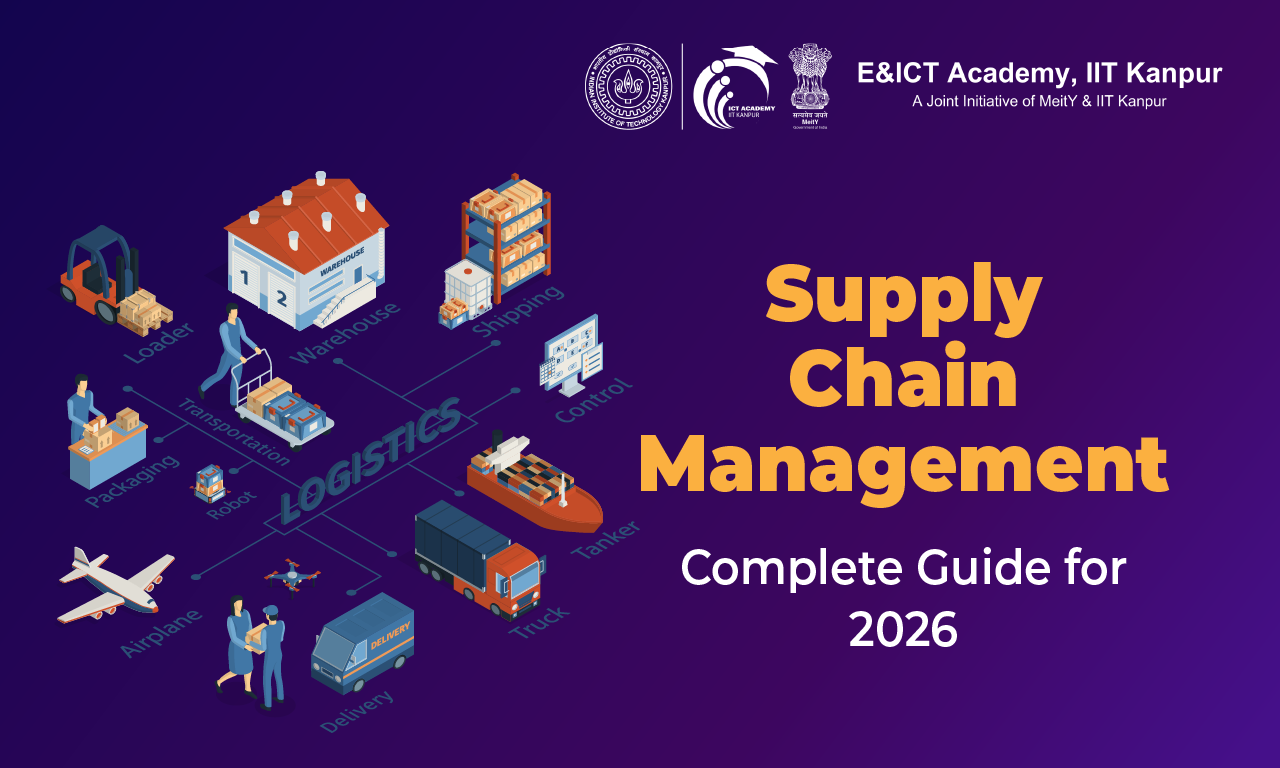
Supply chain management (SCM) is the coordination of everything involved in sourcing raw materials, manufacturing products, and delivering finished goods to customers as efficiently and reliably as possible.
It connects suppliers, manufacturers, warehouses, logistics providers, retailers, and customers into one integrated system that aims to deliver the right product to the right place at the right time, at the lowest practical cost and with consistent quality.
Best Supply Management Course Online: Enroll Now
What Is Supply Chain Management in Simple Terms?
When you click “buy now” on an e-commerce app, a hidden chain of activities starts: stock checks, warehouse picking, packing, courier assignment, transport, tracking, and final delivery to your door-this end-to-end process is the supply chain.
SCM is the system that coordinates the flow of goods, information, and money across all these steps so that products move smoothly, decisions are made on accurate data, and every participant gets paid correctly and on time.
For companies like Amazon, Zara, Flipkart, Meesho, and Zepto, supply chain capability is not a back-office support function; it is a core source of competitive advantage and the backbone of their business models.
Five Core Stages of Supply Chain Management
Stage 1: Planning
Planning means forecasting demand, deciding what to produce, when to produce it, and how much inventory to hold at each point in the chain.
It uses historical data, market trends, seasonality, and increasingly AI-based tools to reduce understocking (lost sales) and overstocking (blocked capital), with AI now cutting demand forecast errors by 20–50% compared to traditional methods.
Stage 2: Sourcing
Sourcing covers finding, evaluating, and managing suppliers who provide raw materials and components at the right quality, cost, and reliability.
Good sourcing looks beyond lowest price to assess capacity, certifications, ethical practices, geographic risk, and long-term relationship fit so that supply keeps flowing even during disruptions.
Stage 3: Manufacturing
Manufacturing is where inputs are converted into finished products through controlled production processes that must balance speed, quality, flexibility, and cost.
Lean and agile manufacturing principles, along with technologies like IoT sensors, autonomous robots, and digital twins, are used to reduce waste, prevent downtime, and adapt quickly to demand changes.
Stage 4: Delivery
Delivery includes warehousing, inventory management, order fulfilment, transportation, and last-mile delivery from distribution centres to customers.
It is one of the most visible parts of SCM to customers and directly shapes their experience, as late or failed deliveries can damage brand perception even when earlier stages were efficient.
Stage 5: Returns Management (Reverse Logistics)
Returns management handles products that come back from customers: receiving, inspecting, deciding on restock, repair, refurbish, or disposal, and issuing refunds or replacements.
In high-return sectors like fashion and electronics, a smooth, transparent returns process is now a key differentiator and ties directly into sustainability through recycling and responsible disposal.
Key Participants in a Supply Chain Network
- Suppliers who provide raw materials and components.
- Manufacturers who convert inputs into finished products.
- Warehouses where goods are stored before distribution.
- Logistics providers who manage transportation between locations.
- Retailers or distributors who connect products to end buyers.
- Customers, whose expectations ultimately drive every decision.
Core Components of Supply Chain Management
- Procurement: Selecting suppliers, negotiating contracts, and managing purchases.
- Inventory management: Balancing enough stock to meet demand without locking up capital in excess goods.
- Logistics: Planning and executing transport, warehousing, and material handling.
- Demand forecasting: Using data and machine learning to predict what customers will need and when.
- Supplier relationship management: Building long-term, collaborative partnerships with key vendors.
- Risk management: Identifying potential disruptions and preparing contingency plans to maintain continuity.
Types of Supply Chain Strategies
- Lean supply chain: Focuses on eliminating waste and minimising inventory, best for stable, predictable demand but more vulnerable to disruption.
- Agile supply chain: Prioritises flexibility and speed, suited to fast-changing markets like fashion and electronics.
- Resilient supply chain: Builds redundancy with backup suppliers, safety stock, and flexible transport to survive shocks.
- Sustainable supply chain: Integrates environmental and social responsibility, including ethical sourcing and reduced carbon footprint, which is increasingly a regulatory requirement.
SCM vs Logistics: What Is the Difference?
Logistics focuses on the movement and storage of goods-transportation, warehousing, and order fulfilment.
Supply chain management is the larger, strategic framework that includes logistics but also covers procurement, supplier management, planning, manufacturing coordination, and returns.
Why Supply Chain Management Matters
- Cost reduction: Efficient SCM lowers inventory, transport, and operating costs, directly improving margins.
- Customer satisfaction: Reliable, on-time, in-full deliveries build trust and repeat business.
- Competitive advantage: Speed and reliability often differentiate similar products in crowded markets.
- Risk resilience: Strong SCM systems spot disruptions earlier and recover faster.
- Sustainability and compliance: Regulations now demand transparent, ethical, and low-impact supply chains.
Technology Shaping SCM in 2026
- AI and predictive analytics: Improve demand forecasts, route planning, procurement, and risk detection.
- IoT and RFID: Provide real-time tracking of location and condition of goods across the chain.
- Digital twins: Simulate supply chain scenarios virtually to test changes safely.
- Blockchain: Create tamper-proof records of product origin and handling, crucial for food, pharma, and luxury.
- Control towers: Central dashboards giving end-to-end, real-time visibility and alerts.
- Autonomous mobile robots (AMRs): Automate warehouse tasks like picking and sorting, now used in a majority of new automation projects.
Key Challenges in Supply Chain Management
- Demand uncertainty driven by fast-changing consumer behaviour and external shocks.
- Supplier reliability and the risk of single points of failure.
- Global complexity across regulations, currencies, and geopolitics.
- Data silos and poor visibility across partners.
- Talent shortages in people who combine SCM expertise with digital and AI skills.
- Pressure to improve sustainability while staying cost-effective.
SCM Software and Platforms
Modern SCM relies on specialised software that unifies planning, procurement, inventory, logistics, and analytics into a single system.
- SAP IBP for integrated demand and supply planning.
- Oracle SCM Cloud for end-to-end visibility and automation.
- Blue Yonder and Kinaxis for AI-driven forecasting and scenario planning.
- Precoro and similar tools for procurement automation in mid-market firms.
Supply Chain Management as a Career in 2026
The global SCM market is projected to reach nearly 31 billion USD by 2026, and demand for skilled professionals is outpacing supply.
Roles include supply chain analyst, logistics coordinator, procurement manager, demand planner, operations manager, and SCM technology specialist, with strong growth in India thanks to e-commerce expansion, manufacturing under PLI, and rising global sourcing from Indian suppliers.
Frequently Asked Questions
What is supply chain management in simple terms?
SCM is the system that coordinates sourcing, manufacturing, storage, transport, and delivery so that products move from raw materials to customers smoothly, on time, and at optimal cost.
What are the five stages of SCM?
Planning, sourcing, manufacturing, delivery, and returns management form the core end-to-end stages.
How is SCM different from logistics?
Logistics is about moving and storing goods, while SCM is the broader strategy that also covers planning, procurement, supplier relationships, and returns.
Is SCM a good career in India?
Yes-India’s manufacturing growth, e-commerce boom, and integration into global supply networks are creating strong, long-term demand for SCM professionals with both operations and technology skills.