Scope of Supply Chain Management in India: Careers, Growth and Future in 2026
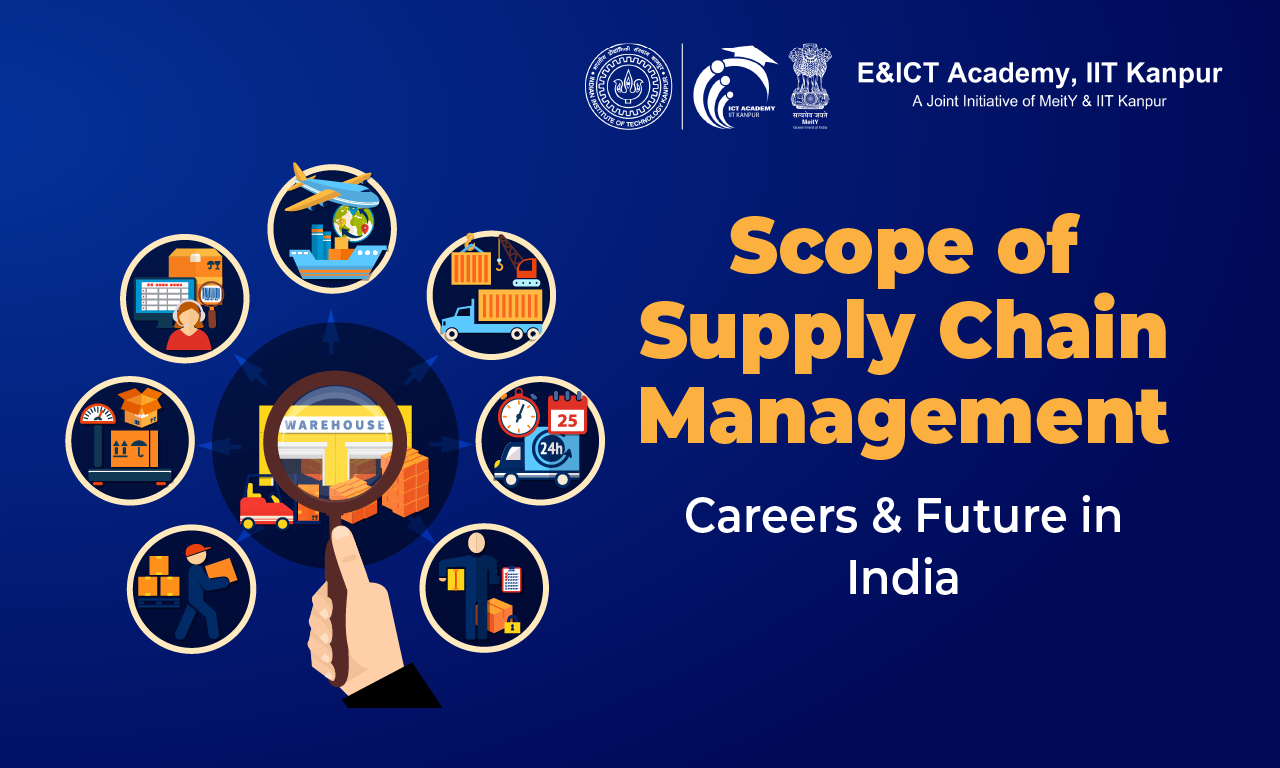
Supply chain management in India offers one of the strongest career trajectories across all management disciplines in 2026. Logistics now contributes nearly 14 percent to India’s national economy, and its growing role explains why a career in supply chain management is being discussed with calm confidence among students and working professionals alike.
The scope spans every sector of the Indian economy: manufacturing, retail, e-commerce, pharmaceuticals, FMCG, automotive, healthcare, and government infrastructure. Entry-level roles are genuinely accessible, mid-level growth is faster than most management careers, and the digital transformation of Indian supply chains is creating entirely new roles that did not exist five years ago.
Best Supply Management Course Online: Enroll Now!!
Why the scope of supply chain management in India is widening in 2026:
- The increasing proliferation of global players in the Indian market, fast-paced technological disruption, and shortened product life cycles are major driving factors behind the growing scope of supply chain management in India.
- Government initiatives including the Gati Shakti Master Plan, National Logistics Policy, and Aatmanirbhar Bharat have created renewed focus on improving India’s logistics infrastructure and performance.
- India’s PLI (Production Linked Incentive) scheme is driving large-scale manufacturing investment in electronics, pharmaceuticals, textiles, and automotive components, creating significant demand for supply chain professionals in these sectors.
- The rapid growth of e-commerce and quick commerce, with companies like Flipkart, Meesho, Zepto, and Blinkit building sophisticated last-mile networks, requires supply chain talent at every level.
What Is Supply Chain Management in India’s Context?
Supply chain management in India covers the end-to-end coordination of getting products from raw material sources to end customers. It includes procurement, production planning, inventory management, warehousing, transportation, demand forecasting, and returns management.
In the Indian context, supply chain management has evolved significantly. Logistics has evolved from being an operational support activity to a key business function leveraging technology, distribution networks, warehouse systems, and transportation systems. This evolution means the profession now demands a combination of operational knowledge, analytical capability, and technology fluency that makes it both more challenging and more rewarding than it was a decade ago.
India’s geographic diversity, the complexity of its multi-modal transport infrastructure, the range of regulatory environments across states, and the diversity of its consumer base make Indian supply chain management a genuinely complex discipline that develops skills applicable globally.
Career Opportunities in Supply Chain Management in India
Entry-Level Roles (0 to 2 Years)
Entry into supply chain management in India is accessible from a range of educational backgrounds including engineering, commerce, business administration, and even arts. The skills that matter most at entry level are basic analytical ability, attention to detail, and willingness to learn operations on the ground.
Common entry-level positions include procurement executive, inventory coordinator, logistics support executive, warehouse operations associate, and supply chain analyst trainee.
- Procurement executive: Supports supplier communications and purchase order management.
- Inventory coordinator: Maintains stock records and supports replenishment.
- Logistics support executive: Coordinates shipments and carrier communications.
- Warehouse operations associate: Manages receiving, storage, and despatch activities.
- Supply chain analyst trainee: Supports data analysis and reporting in planning teams.
Fresher salaries in supply chain management in India typically range from Rs. 3.5 to Rs. 6 LPA, with graduates from reputed institutions joining large FMCG, e-commerce, or manufacturing companies starting at Rs. 6 to Rs. 10 LPA.
Mid-Level Roles (2 to 6 Years)
Mid-level supply chain roles in India offer significantly higher salaries and greater strategic involvement. This is the career stage where specialisation begins to differentiate professionals.
Strong mid-level positions include demand planner, supply chain analyst, warehouse supervisor, sourcing specialist, and logistics coordinator.
- Demand planner: Forecasts future demand and coordinates inventory positioning.
- Supply chain analyst: Builds performance dashboards and analyses OTIF, inventory, and cost data.
- Warehouse supervisor: Manages day-to-day operations of a distribution facility.
- Sourcing specialist: Manages supplier relationships and category procurement.
- Logistics coordinator: Manages carrier networks and freight cost optimisation.
Mid-level salaries range from Rs. 8 to Rs. 18 LPA depending on specialisation, company size, and city. Professionals who develop technical skills in SAP, data analytics, or demand planning tools consistently earn at the upper end of this range.
Read More: Sustainable Supply Chain and ESG
Senior-Level and Leadership Roles (6 Years and Above)
Senior supply chain roles in India carry significant business responsibility and compensation. Senior professionals are no longer just operations managers. They play a pivotal role in business growth and customer satisfaction, working closely with C-suite executives to drive digital transformation, design sustainable logistics networks, and align supply chain practices with broader corporate strategies.
- Supply chain manager: Rs. 18 to Rs. 35 LPA.
- Procurement manager: Rs. 18 to Rs. 30 LPA.
- Logistics director: Rs. 30 to Rs. 50 LPA.
- VP or Head of Supply Chain: Rs. 40 LPA and above.
With career progression, professionals have the potential to rise to senior roles such as Vice President of Supply Chain and Logistics, overseeing entire supply chain operations within specific business segments or product categories.
Industries Driving Supply Chain Careers in India
E-commerce and Quick Commerce: Flipkart, Amazon India, Meesho, Zepto, Blinkit, and Swiggy Instamart are among the largest employers of supply chain talent in India. The demand for last-mile delivery expertise, fulfilment centre management, and real-time inventory systems is growing rapidly in this sector.
Manufacturing (PLI Sectors): Electronics, pharmaceuticals, textiles, and auto components manufacturers expanding under the PLI scheme need procurement, production planning, and quality systems professionals. This is one of the fastest-growing demand segments for supply chain talent in India.
FMCG: Companies like Hindustan Unilever, ITC, Marico, and Dabur operate large, complex distribution networks across India. These companies offer structured supply chain career paths with strong training programmes and international mobility.
Pharmaceuticals: India is the world’s largest supplier of generic medicines. Pharmaceutical supply chains require expertise in cold chain management, regulatory compliance, and global export logistics, all of which command premium compensation.
Automotive: Maruti Suzuki, Tata Motors, Mahindra, and the growing EV sector require professionals who can manage complex multi-tier supplier networks with just-in-time delivery requirements.
Retail: The organised retail sector including DMart, Reliance Retail, and Tata Retail requires supply chain professionals who can manage inventory across hundreds of locations while maintaining service levels in a highly competitive, margin-sensitive environment.
Also Read: Agentic AI in Supply Chain Management
Emerging Roles Specific to 2026
The digital transformation of Indian supply chains is creating roles that did not exist five years ago and that command premium compensation because the skills are genuinely scarce.
- Supply Chain Data Analyst: Combines domain knowledge with proficiency in SQL, Python, and Power BI to build forecasting models, performance dashboards, and exception management systems. Salary range: Rs. 8 to Rs. 20 LPA at mid-level.
- Demand Planning Specialist (AI-assisted): Works alongside AI-powered planning tools like SAP IBP and Blue Yonder to manage the S&OP process and improve forecast accuracy.
- Sustainability and ESG Compliance Manager: Manages supply chain carbon measurement, supplier sustainability audits, and ESG reporting.
- Digital Twin and Simulation Specialist: Supports the implementation and operation of digital twin platforms for supply chain network design and scenario planning.
- Supply Chain Technology Manager: Oversees the selection, implementation, and optimisation of the technology stack across the supply chain function.
| Related Articles | |
|---|---|
| Supply Chain Manager Job Description | How to Write a Supply Chain Manager Resume |
| Supply Chain Management Salary in India | Supply Chain Management Skills |
How to Start and Grow a Career in Supply Chain Management in India
Educational pathways: A bachelor’s degree in engineering, commerce, or business provides a strong foundation. An MBA with a specialisation in operations or supply chain management, particularly from institutions like IIMs, NITIE, XLRI, and SP Jain, provides the fastest path to management roles and the highest starting salaries. For working professionals, a Post Graduate Diploma in Supply Chain Management or a targeted certification programme provides structured upskilling without the time commitment of a full MBA.
Certifications that accelerate career growth in India: APICS CPIM and APICS CSCP are the most globally recognised credentials and consistently appear in senior supply chain job postings in India. Six Sigma Green Belt or Black Belt demonstrates process improvement capability valued across manufacturing and operations roles. SAP certification in MM, IBP, or S/4HANA is a practical differentiator in the large number of Indian enterprises running SAP.
Skills that drive career growth: Data analytics proficiency in Excel, SQL, and Power BI is the most consistently demanded skill differentiator at every level above entry. ERP system knowledge, particularly SAP, is expected at mid-level and above in most large companies. Cross-functional communication skills that allow supply chain professionals to engage effectively with finance, sales, and operations leadership are critical for advancement beyond specialist roles.
Also Read: Supply Chain Manager Job Description
The Future of Supply Chain Management in India
The future of supply chain management in India looks extremely promising due to technological advancements and globalisation. AI and automation in warehousing and predictive analytics are transforming supply chain planning. The e-commerce boom requires efficient last-mile delivery networks, increasing demand for trained logistics professionals. Companies are adopting eco-friendly packaging, electric delivery fleets, and carbon tracking, creating new roles in sustainable supply chain management.
Several specific trends will shape supply chain careers in India over the next five years.
- AI-powered planning: AI is improving demand forecasting accuracy by 20 to 50 percent in documented deployments. Professionals who can work alongside AI tools, evaluate their outputs critically, and translate AI-generated insights into operational decisions will be increasingly valuable.
- Sustainability requirements: India’s integration into global supply chains, combined with the SEBI BRSR framework and customer requirements from European buyers, is creating growing demand for professionals who understand carbon measurement, ethical sourcing, and ESG reporting.
- Quick commerce infrastructure: The 10 to 30-minute delivery model operating in Indian metros requires sophisticated micro-fulfilment, hyperlocal inventory management, and real-time route optimisation.
- Government infrastructure investment: The Gati Shakti Master Plan is developing multi-modal logistics infrastructure across India, including dedicated freight corridors, logistics parks, and port connectivity improvements.
As individuals move up the career ladder, responsibilities shift from day-to-day operations to strategic decision-making. Senior leaders focus on aligning logistics strategies with business goals, implementing global systems, and driving innovation in the organisation.
The professionals who will lead Indian supply chains in 2030 are those who combine operational depth with data fluency, technology adaptability, and the communication skills to engage at the business strategy level. Building this combination of capabilities now, through structured learning, hands-on project experience, and professional certification, is the investment that will produce the highest career returns over the next decade.
Frequently Asked Questions
What is the scope of supply chain management in India in 2026?
The scope is broad and growing across manufacturing, e-commerce, pharmaceuticals, FMCG, automotive, and retail sectors. Logistics contributes nearly 14 percent to India’s national economy. Government initiatives including the Gati Shakti Master Plan, National Logistics Policy, and PLI scheme are driving infrastructure investment and manufacturing expansion that directly increases demand for supply chain professionals at every level.
What are the entry-level jobs in supply chain management in India?
Common entry-level roles include procurement executive, inventory coordinator, logistics support executive, warehouse operations associate, and supply chain analyst trainee. Starting salaries range from Rs. 3.5 to Rs. 6 LPA for fresh graduates, with higher packages of Rs. 6 to Rs. 10 LPA at larger companies and for graduates from reputed institutions.
Which industries offer the most supply chain jobs in India?
E-commerce and quick commerce, FMCG, pharmaceutical manufacturing, PLI scheme electronics and auto components manufacturers, organised retail, and third-party logistics providers are the highest-volume employers of supply chain talent in India in 2026.
What skills are most important for supply chain careers in India in 2026?
Data analytics proficiency in Excel, SQL, and Power BI is the most consistently demanded differentiator. ERP system knowledge, particularly SAP, is expected at mid-level and above in most large companies. Demand planning and forecasting skills, cross-functional communication, and familiarity with AI-powered planning tools are increasingly important as Indian supply chains become more technology-intensive.
What certifications help build a supply chain career in India?
APICS CPIM and APICS CSCP are the most globally recognised and widely valued certifications in India. Six Sigma Green Belt demonstrates process improvement capability valued in manufacturing and operations. SAP certification in relevant modules is a practical differentiator in the large number of Indian enterprises running SAP. For data-focused roles, Power BI or Tableau certification alongside SCM domain knowledge is a strong combination.
Is supply chain management a good career in India for freshers?
Yes. Supply chain management is one of the most accessible management careers for freshers from diverse educational backgrounds. Entry-level roles are available without prior experience, the learning curve is steep and therefore the growth to mid-level is faster than many other fields, and the digital transformation of Indian supply chains is creating new roles that reward analytical and technology skills that younger professionals are well-positioned to develop.