Supply Chain Management Skills: 15 Must-Have Skills to Master in 2026
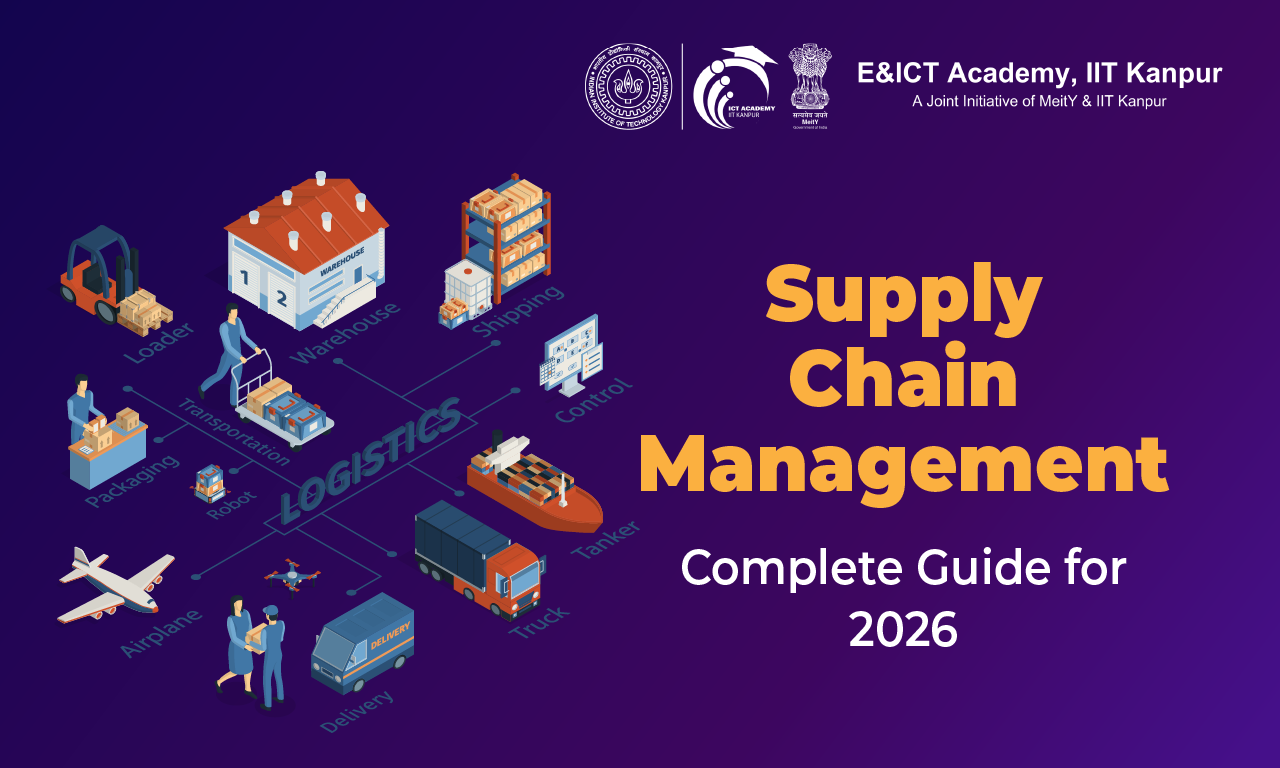
Supply chain management professionals in 2026 need a combination of technical, analytical, and interpersonal skills to manage increasingly complex global operations.
The most in-demand technical skills include data analytics and visualisation, ERP and SCM software proficiency, AI and machine learning literacy, demand planning and inventory management, logistics and transportation management, procurement and supplier relationship management, sustainability and ESG compliance, and risk management and supply chain resilience.
The most important strategic and soft skills include critical thinking and problem solving, cross-functional communication and stakeholder management, negotiation and contract management, change management and technology adoption, financial acumen and cost analysis, project management and process improvement, and leadership and team development.
Best Supply Management Course Online: Enroll Now!
The supply chain management sector is projected to grow 17 percent between 2024 and 2034, significantly faster than most other career fields. In India, a certified Supply Chain Analyst can expect to earn between Rs. 6 to 10 LPA, with senior roles reaching Rs. 20 LPA and above.
Why Supply Chain Skills Are Changing So Rapidly in 2026
Five years ago, a strong SCM professional needed solid logistics knowledge, good organizational skills, and familiarity with ERP systems. That baseline still matters, but it is no longer sufficient.
Supply Management Course Online: Enroll Now!
First, global disruptions from the pandemic years through geopolitical shifts have moved supply chain resilience from an operational consideration to a board-level strategic priority. Businesses now expect Supply Chain Management professionals to anticipate and manage risk, not just respond to it.
Second, AI-powered tools for demand forecasting, inventory optimization, route planning, and supplier risk assessment have become mainstream. Professionals who cannot work alongside these tools are at a measurable disadvantage compared to those who can.
Third, sustainability regulations are tightening globally, with the EU Supply Chain Due Diligence Directive and similar regulations in other markets requiring documented transparency throughout supply networks. This has created demand for professionals who understand ESG compliance as a practical operational requirement, not just a corporate communications exercise.
According to SCOPE Recruiting’s 2026 supply chain job market analysis, skills in AI-adjacent supply chain roles are changing 25 percent faster than in roles less affected by AI. This pace of change means that continuous learning is not optional for anyone building a long-term career in this field.
The 15 Must-Have Supply Chain Management Skills in 2026
Skill 1: Data Analytics and Visualization
Data analytics is the single most consistently mentioned skill gap across supply chain hiring in 2026. Every stage of the supply chain produces data, and the professionals who can interpret that data, identify what it means for business decisions, and communicate findings clearly to non-technical stakeholders are the ones getting promoted and hired.
This skill does not require becoming a data scientist. It requires practical comfort with building dashboards, running queries, identifying trends, and presenting insights in a way that drives decisions.
Tools to learn: SQL for querying databases, Power BI or Tableau for visualization, Excel or Google Sheets for operational analysis, and Python basics for automating repetitive data tasks.
Why it matters in 2026: AI-powered planning tools generate more data than ever before. The professionals who can evaluate, question, and act on that data output are more valuable than those who simply report what the tool shows.
How to develop it: Start with free SQL tutorials, build dashboards using public supply chain datasets, and practice preparing performance summaries for decision-makers.
Skill 2: ERP and SCM Software Proficiency
Enterprise Resource Planning systems are the operational backbone of most supply chains. SAP, Oracle, and Microsoft Dynamics remain dominant in large organizations, and the ability to navigate these systems, configure workflows, and extract meaningful reports is a baseline requirement in many SCM roles.
Beyond general ERP knowledge, specialized supply chain platforms such as Blue Yonder, Kinaxis, and Manhattan Associates are appearing more frequently in job descriptions.
Tools to learn: SAP IBP or SAP S/4HANA, Oracle SCM Cloud, Blue Yonder, and Kinaxis Maestro.
Why it matters in 2026: Companies are investing heavily in upgraded SCM technology stacks, and professionals who can use and support these systems are much more valuable.
How to develop it: Use vendor learning hubs, free certification tracks, and internal training modules if your organization already uses these tools.
Skill 3: AI and Machine Learning Literacy
Artificial intelligence is now embedded in many modern SCM platforms. AI handles demand forecasting, anomaly detection, supplier risk scoring, route optimization, and predictive maintenance scheduling.
The skill that matters most is AI literacy: understanding how these tools work well enough to interpret their outputs, challenge them when needed, and apply human judgment effectively.
Tools to learn: AI features inside SAP IBP, Blue Yonder, and Oracle SCM Cloud, plus operational use of assistants like ChatGPT and Gemini.
Why it matters in 2026: AI can reduce forecast errors substantially, but only when professionals know how to evaluate the quality of the output.
How to develop it: Study introductory AI courses, read platform documentation, and practice comparing AI-generated recommendations against your own judgment.
Skill 4: Demand Planning and Forecasting
Demand planning is the ability to predict what customers will want, when they will want it, and in what quantity, so that inventory, production, and logistics resources can be positioned correctly.
In 2026, demand planning increasingly combines historical data with real-time signals such as social media trends, weather patterns, and economic indicators.
Tools to learn: SAP IBP, Blue Yonder Luminate, Oracle Demand Management Cloud, and core forecasting methods such as moving averages, exponential smoothing, and ARIMA.
Why it matters in 2026: Accurate forecasting has become both more valuable and more difficult because supply chains face higher volatility.
How to develop it: Study forecasting fundamentals and practise measuring forecast accuracy using metrics such as MAPE.
Skill 5: Procurement and Supplier Relationship Management
Procurement includes identifying suppliers, evaluating capabilities and risks, negotiating contracts, managing ongoing relationships, and ensuring reliable delivery at the right quality and cost.
In 2026, procurement has become more strategic because supplier diversification, financial health monitoring, sustainability assessment, and digital procurement platforms are now standard expectations.
Tools to learn: SAP Ariba, Coupa, supplier risk platforms such as Resilinc or Riskmethods, and total cost of ownership frameworks.
Why it matters in 2026: A single supplier failure can halt an entire production network, so strong supplier judgment creates direct competitive advantage.
How to develop it: Build skills in total cost analysis, supplier assessment, and structured sourcing frameworks.
Also Read: What Is Supply Chain Management
Skill 6: Logistics and Transportation Management
Logistics knowledge covers how goods physically move through the supply chain, including transport mode selection, carrier management, freight cost optimization, customs compliance, and warehouse operations.
In 2026, professionals increasingly need to work with Transportation Management Systems, understand last-mile delivery economics, and manage multi-modal networks across borders.
Tools to learn: Oracle TMS, Blue Yonder TMS, MercuryGate, freight marketplaces, carrier APIs, and Incoterms 2020.
Why it matters in 2026: Logistics costs form a major share of total supply chain cost, and last-mile delivery remains one of the most expensive and complex stages.
How to develop it: Study logistics certifications, freight market resources, and gain direct exposure to carrier negotiations and TMS workflows.
Skill 7: Inventory Management
Inventory management is the discipline of maintaining optimal stock levels across the supply network: enough to serve demand reliably, but not so much that working capital gets trapped in slow-moving stock.
It includes safety stock calculation, reorder point analysis, ABC classification, cycle counting, turnover analysis, and understanding the trade-off between lean and buffer inventory.
Tools to learn: Manhattan Associates, SAP Extended Warehouse Management, Blue Yonder WMS, Excel, Python, and concepts such as Just-in-Time and Just-in-Case inventory.
Why it matters in 2026: Businesses need scientifically grounded inventory targets that balance cost, service level, and risk.
How to develop it: Practice safety stock and reorder point calculations under different demand and lead time assumptions.
Skill 8: Risk Management and Supply Chain Resilience
Risk management in supply chain means identifying disruption risks, assessing their impact, planning contingencies, and building enough redundancy to keep the business running when something fails.
In 2026, this has become a core competency rather than a niche specialization because efficiency-only networks have repeatedly proved too fragile.
What this skill involves in practice: Supplier mapping, disruption scenario planning, dual-source strategies, nearshoring analysis, and business continuity planning.
Why it matters in 2026: Supply chain resilience is now a boardroom concern, not just an operations issue.
How to develop it: Build supplier risk maps, identify concentration risk, and practice communicating risk positions in business language.
Skill 9: Sustainability and ESG Compliance
Sustainability has become a core operational requirement rather than a side initiative. Regulations increasingly require documented transparency, ethical sourcing, carbon tracking, and supplier sustainability verification.
This skill includes understanding Scope 1, 2, and 3 emissions, supplier audits, green logistics, circular economy principles, and ESG documentation.
Why it matters in 2026: Companies that cannot demonstrate supply chain sustainability face regulatory restrictions, reputational damage, and lost business opportunities.
How to develop it: Study GHG Protocol, CSRD requirements, and practical sustainability disclosure resources.
Skill 10: Critical Thinking and Problem Solving
Supply chains operate in conditions of constant uncertainty. Professionals need the ability to analyze a problem quickly, identify root causes rather than symptoms, evaluate options, and implement the best solution under pressure.
Structured frameworks such as PDCA, Root Cause Analysis, 5 Whys, and Fishbone diagrams are practical tools used regularly in SCM environments.
Why it matters in 2026: Problems emerge constantly, and the people who solve them faster and more reliably advance faster in their careers.
How to develop it: Practice structured diagnosis on real problems and improve how you define and communicate root causes.
Skill 11: Cross-Functional Communication and Stakeholder Management
Supply chain professionals interact with finance, procurement, operations, sales, IT, legal, and senior leadership. Each stakeholder group cares about different outcomes and uses different language.
The ability to translate supply chain complexity into useful, role-specific business language is rare and highly valuable.
Why it matters in 2026: Most important supply chain decisions are increasingly made across functions rather than within a single team.
How to develop it: Practice short executive summaries, cross-functional presentations, and clearer business writing.
Skill 12: Negotiation and Contract Management
Supplier negotiations directly affect price, service quality, risk exposure, payment terms, and delivery reliability. Contract management ensures the business’s interests are protected throughout the supplier relationship.
In tight supply markets, strong negotiation and contractual clarity can determine whether a company gets priority access or gets deprioritized.
Why it matters in 2026: Good negotiation now affects both cost and resilience, not just procurement savings.
How to develop it: Study negotiation frameworks such as BATNA and build familiarity with key contract clauses like liability, indemnification, and force majeure.
Skill 13: Financial Acumen and Cost Analysis
Supply chain decisions are financial decisions. Choices about inventory, supplier selection, transport mode, warehouse location, and order quantity all affect cost, cash flow, and profitability.
Professionals who understand total cost of ownership, working capital, ROI, and P&L impact make stronger recommendations and have more influence in leadership discussions.
Key financial concepts: TCO, DSI, DPO, working capital, NPV, and COGS analysis.
Why it matters in 2026: Supply chain leaders are expected to frame decisions in financial terms, not only operational terms.
How to develop it: Practice simple supply chain financial models, such as comparing supplier options using total cost.
Skill 14: Project Management and Process Improvement
Most major supply chain improvements happen through projects, such as implementing a new WMS, changing suppliers, redesigning a network, or deploying a planning tool.
Process improvement frameworks such as Lean and Six Sigma help teams identify waste, reduce variation, and improve reliability.
Tools and frameworks to know: Scope, schedule, budget, risk management, Lean principles, value stream mapping, Six Sigma DMAIC, and project tools like Microsoft Project, Jira, or Smartsheet.
Why it matters in 2026: Supply chain digital transformation is continuous, so organizations need professionals who can deliver projects that actually stick.
How to develop it: Study project management or Lean Six Sigma certification pathways and practice mapping and improving real processes.
Skill 15: Leadership and Change Management
New technology and redesigned processes only work when people actually adopt them. Leadership and change management are therefore essential, not optional, in modern SCM careers.
As teams become more distributed and more cross-functional, coaching, delegation, feedback, communication, and conflict resolution matter at every level.
Why it matters in 2026: Technology implementation often fails because people resist change, not because the tool itself is weak.
How to develop it: Study change frameworks like ADKAR, lead small change initiatives, and gather feedback on how your communication works during transitions.
Technical Skills vs Soft Skills: How They Work Together
A common misconception is that technical SCM skills and soft skills sit in separate categories. In reality, they constantly reinforce each other.
A demand planner who builds a strong forecast but cannot explain it clearly will struggle to get action. A procurement professional who negotiates well but lacks cost analysis will make weaker sourcing decisions. A supply chain leader who understands technology but cannot lead change will struggle to realize implementation value.
The professionals who advance fastest build genuine depth in a few technical areas while also developing the communication and leadership skills needed to make that expertise useful across the organisation.
Recommended Certifications for Supply Chain Professionals in 2026
Certifications help demonstrate that your skills meet an established industry standard. In a competitive market, they also help distinguish serious, capable candidates from those who simply claim familiarity.
- APICS CPIM: Covers demand management, inventory planning, supplier relationships, and supply chain finance.
- APICS CSCP: A broader end-to-end certification suited for strategic and cross-functional roles.
- ISM CPSM: Strong for procurement and sourcing careers.
- Lean Six Sigma Green Belt or Black Belt: Valuable where process improvement and waste reduction matter.
- SAP Certified Application Associate: Strong proof of platform-level technical knowledge.
- Google Data Analytics or Microsoft Power BI Certification: Useful for professionals building analytics credibility.
In India, the EICTA Advanced Supply Chain Management Programme at IIT Kanpur provides structured coverage of both technical and strategic supply chain skills.
How to Prioritise These Skills Based on Your Career Stage
Not every skill deserves equal attention at every stage of a supply chain career.
- If you are starting your SCM career: Focus on data analytics basics, ERP familiarity, and understanding the end-to-end supply chain process.
- If you have two to five years of experience: Deepen specialization in areas such as demand planning, procurement, or logistics management, while strengthening communication and financial acumen.
- If you are in a senior or leadership role: Focus on AI literacy, ESG compliance, network-level risk management, and change leadership.
Supply Chain Management Skills in the Indian Context
India’s supply chain talent market in 2026 has some distinct features. The expansion of e-commerce is creating strong demand for professionals with logistics, warehouse, and last-mile delivery expertise, particularly beyond metro cities.
Manufacturing growth under PLI in sectors such as electronics, pharmaceuticals, textiles, and automotive is also increasing demand for procurement, planning, and supplier management capabilities.
The Indian IT services sector is another major employer of SCM technology talent, especially for professionals who understand both ERP platforms and business operations.
For Indian professionals, the strongest salary premiums are typically associated with data analytics plus SCM knowledge, SAP or ERP implementation experience, and sustainability compliance capability.
Frequently Asked Questions
What are the most important supply chain management skills in 2026?
The most consistently demanded skills are data analytics and visualization, ERP and SCM software proficiency, AI literacy, demand planning, risk management, and cross-functional communication.
How long does it take to learn supply chain management skills?
Foundational understanding can often be built in three to six months through structured learning. Practical technical proficiency usually takes six to twelve months, while mastery in more advanced areas often takes two to three years of applied experience.
Do I need a degree to work in supply chain management?
A degree helps, but employers often care more about demonstrated skills, practical experience, and recognized certifications than formal credentials alone.
Which supply chain certification is best in 2026?
APICS CPIM is one of the strongest entry-level credentials, while APICS CSCP and ISM CPSM are highly respected for mid-career professionals. SAP and analytics certifications add strong practical value for technology-focused roles.
How is AI changing supply chain management skills requirements?
AI is automating many routine calculation and reporting tasks, which raises the baseline expectation for human professionals. The most valuable new skills are interpreting AI outputs critically, applying judgment, and communicating AI-driven insights clearly.
Is supply chain management a good career in India in 2026?
Yes. India’s expanding manufacturing base, fast-growing e-commerce sector, and larger role in global supply networks are creating strong demand for skilled SCM professionals.
What is the difference between logistics skills and supply chain management skills?
Logistics skills focus on transportation, warehousing, freight cost analysis, and distribution operations. Supply chain management skills are broader and include logistics along with procurement, demand planning, supplier management, finance, and strategic decision-making across the full lifecycle.