AI in Digital Marketing: The Complete 2026 Guide for Marketers
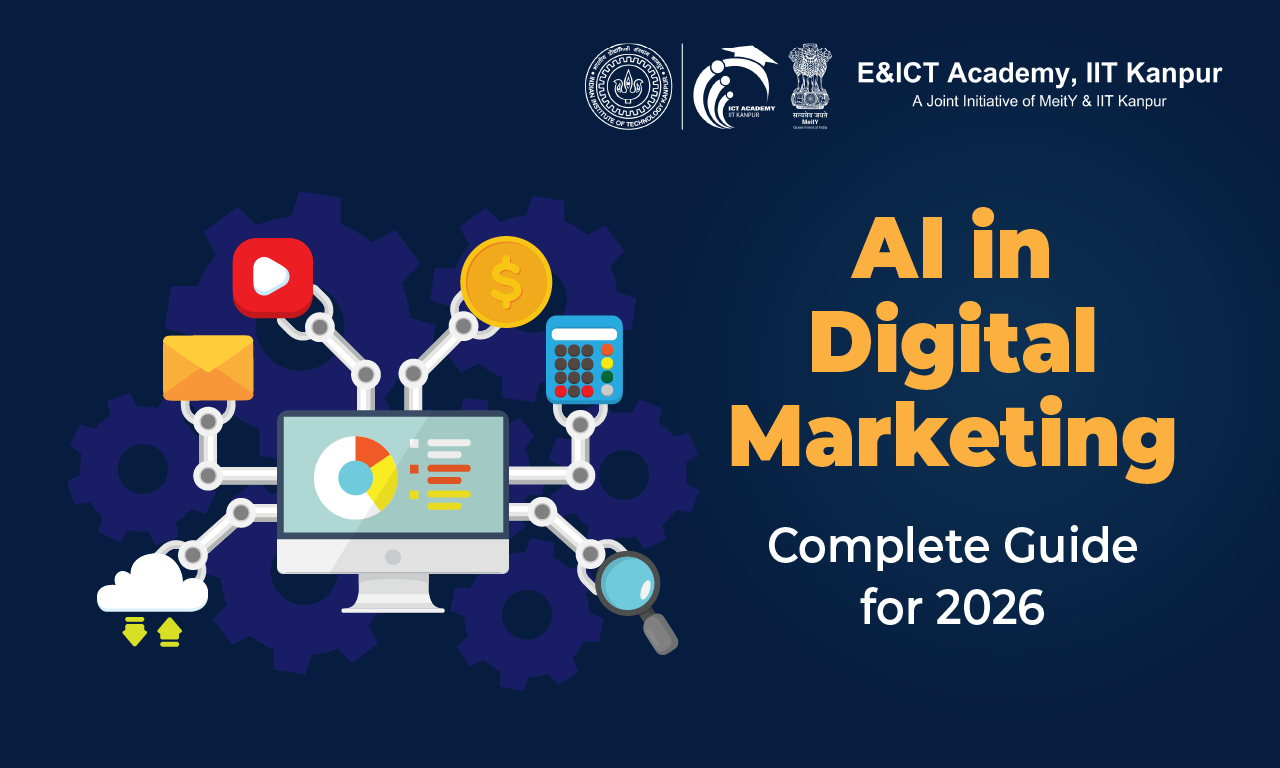
Artificial intelligence in digital marketing refers to the use of machine learning, automation, predictive analytics, and generative AI to improve campaign performance, personalise customer experiences, and optimise spend across every digital channel.
In 2026, AI is not a separate tool that marketers use alongside their existing workflow. It is built into the platforms they already use: Google Ads uses AI to set bids and generate creative variants. Meta Ads uses AI to optimise targeting and creative selection. HubSpot uses AI to score leads and personalise email sequences. Salesforce uses AI to predict churn and recommend next-best actions.
Best Digital Marketing Course Online: Enroll Now!
The scale of AI adoption in marketing in 2026:
- AI in marketing is a $190 billion reality reshaping how brands connect with customers.
- 84 percent of marketers use AI for real-time personalisation and 80 percent report that AI helps them respond to customer needs more quickly, according to Salesforce’s State of Marketing report.
- Marketing teams using AI-powered optimisation see 30 percent higher ROI on advertising spend compared to manual optimisation.
- Modern AI chatbots handle up to 80 percent of routine customer questions without needing a human agent.
- By 2026, there is 82 percent demand for prompt engineering skills among marketing teams, with only a small number of professionals currently qualified.
What AI Does Across the Marketing Function
| Marketing Function | What AI Does | Primary Platforms |
|---|---|---|
| Content creation | Drafts, personalises, and optimises content at scale | Jasper, ChatGPT, Copy.ai |
| SEO and search | Keyword research, content briefs, GEO optimisation | Semrush AI, Surfer SEO, Frase |
| Paid advertising | Real-time bidding, audience targeting, creative testing | Google Performance Max, Meta Advantage+ |
| Email marketing | Send-time optimisation, segmentation, personalisation | HubSpot, Mailchimp AI, Klaviyo |
| Social media | Scheduling, content suggestions, performance analysis | Buffer AI, Sprout Social |
| Analytics | Predictive insights, attribution modelling, anomaly detection | GA4, Tableau, HubSpot AI |
| Customer service | 24/7 automated support, lead qualification | Intercom, Drift, Zendesk AI |
What Is AI in Digital Marketing?
AI in digital marketing means using software that learns from data to make better decisions about how to reach, engage, and convert customers. Rather than following fixed rules, AI systems improve over time by analysing what works and adjusting their behaviour accordingly.
Three categories of AI are most relevant to marketers in 2026.
Machine learning analyses historical data to identify patterns and make predictions. When Google Ads recommends a bid adjustment or a CRM platform predicts which leads are most likely to convert, machine learning is driving the recommendation.
Generative AI creates original content from a prompt: text, images, video, audio, and code. Tools like ChatGPT, Jasper, and Canva AI use generative models to produce marketing content at a speed and scale that would be impossible manually.
Agentic AI goes beyond generating content or making recommendations to actually executing tasks autonomously. An agentic marketing system does not just suggest a bid adjustment. It makes the adjustment, monitors the result, and continues optimising without waiting for a human to approve each step. This is the most significant development in AI marketing in 2026.
Read More: Cookieless Marketing in 2026
How AI Is Transforming Digital Marketing in 2026
Generative AI for Content Creation
Generative AI has fundamentally changed the economics of content production. What previously required hours of writing, editing, and formatting can now be produced in minutes with AI assistance.
The most effective approach in 2026 is AI-assisted creation, where AI produces the first draft, structure, and variations while human editors refine for brand voice, accuracy, and genuine insight. This approach typically reduces content production time by 50 to 70 percent while maintaining the quality standards that both readers and search engines expect.
AI content tools excel at generating blog outlines and first drafts, writing multiple ad copy variations for A/B testing, personalising email content for different audience segments, creating social media captions adapted for different platforms, and producing product descriptions at scale for e-commerce catalogues.
The critical limitation to understand is that AI-generated content without human review is detectable, brand-inconsistent, and often factually imprecise. The human editorial role has not diminished. It has shifted from production to direction and quality control.
AI-Powered SEO and Generative Engine Optimisation
SEO has split into two distinct disciplines in 2026: traditional search optimisation and Generative Engine Optimisation (GEO).
Traditional SEO uses AI tools to identify keyword opportunities, analyse competitor content gaps, optimise on-page elements, and monitor ranking performance. Tools like Semrush AI, Surfer SEO, and Frase automate much of the research and analysis that previously required significant manual effort.
GEO is the newer and more strategically important discipline. SEO in 2026 is an AI-assisted, intent-driven discipline. Tactics include using AI analytics to identify content gaps, optimising for voice and visual search, improving site experience through Core Web Vitals and mobile UX, and building a content ecosystem that demonstrates authority on your topic.
GEO optimises content specifically to be cited in AI-generated answers from Google AI Overviews, ChatGPT, Perplexity, and Gemini. The structural requirements for GEO differ from traditional SEO: direct answers in the opening of each section, question-format headings that mirror real search queries, verified statistics from named sources, and FAQPage schema markup that formats content for AI extraction.
For any digital marketer managing content in 2026, GEO is no longer optional. A significant and growing proportion of brand discovery happens through AI-mediated search, and brands not optimising for it are missing an increasingly important visibility channel.
Predictive Analytics and Customer Intelligence
Real-time analytics platforms powered by machine learning monitor campaign performance across channels, identify which creative assets drive conversions, automatically allocate budget to top performers, and pause underperforming elements before wasting spend.
Predictive analytics moves marketing from reactive to proactive. Rather than analysing what happened in last month’s campaign, predictive models forecast what is likely to happen next, which customers are at risk of churning, which leads are most likely to convert this week, and which creative approach will resonate with a specific audience segment.
One global airline discovered that frequent flight delays were causing customers to switch to other brands. By integrating AI in digital marketing, they began sending tailored compensation offers to passengers the moment a delay was logged. This resulted in an 800 percent jump in customer satisfaction and a 59 percent drop in churn among their most valuable customers.
This real-world example illustrates the core principle: AI-powered predictive analytics enables marketing interventions at precisely the right moment with precisely the right message, before the customer makes an adverse decision.
Programmatic Advertising and AI Bidding
Google Performance Max and Meta Advantage+ represent the current state of AI-powered paid advertising. Both systems use machine learning to automatically optimise bidding, creative selection, audience targeting, and budget allocation across their entire ad inventory simultaneously.
Rather than manually managing keywords, audiences, and bids, marketers using these platforms set objectives and provide creative assets. The AI determines the most efficient path to achieving those objectives in real time, making thousands of micro-optimisations per day that no human campaign manager could execute manually.
One trend in paid media is cross-platform automation using unified dashboards or third-party AI tools that manage spend across different channels, including search, social, and display, to optimise the overall marketing mix. If social ads become expensive, an AI system might reallocate budget to search where ROI is better automatically.
AI Chatbots and Conversational Marketing
AI chatbots have become significantly more sophisticated in 2026. They provide customer support, suggest products, and assist customers across websites and messaging platforms. By using AI, brands can respond to customers faster, qualify leads automatically, improve customer satisfaction, and provide support continuously.
In the Indian market, WhatsApp AI chatbots represent a particularly high-value application. Given WhatsApp’s dominant role in Indian business communication, AI-powered WhatsApp Business API deployments that handle customer queries, provide product recommendations, process orders, and manage post-purchase communication are delivering significant operational efficiency for consumer businesses.
The quality threshold for AI chatbots has risen significantly. Customers who encounter obviously scripted, unhelpful responses lose trust in the brand. Chatbots that handle routine queries well, escalate complex issues appropriately, and maintain a consistent brand voice are genuinely valuable. Chatbots that frustrate customers are worse than having no chatbot at all.
Also Read: How to Use ChatGPT for Digital Marketing
AI in Social Media Marketing
Social media platforms prioritise AI-generated short-form video, with algorithms favouring consistent, high-quality visual content. AI video generation tools enable marketers to produce professional-quality video content from scripts in hours rather than weeks.
Beyond video, AI in social media covers audience sentiment analysis, optimal posting time prediction, influencer identification based on audience overlap and engagement authenticity, and content performance prediction before posting.
Marketing teams using AI-powered optimisation complete significantly more improvement cycles over a year than teams working manually, compounding the performance advantage over time.
Agentic AI in Marketing: The 2026 Frontier
The most significant development in AI marketing in 2026 is the shift from AI that recommends to AI that acts. Agentic marketing systems operate autonomously toward defined marketing objectives without requiring human approval at every step.
The future of AI in digital marketing is all about autonomous marketing. AI will not just suggest ads but actually build them, buy the space, and track the money on its own. The marketer’s job is moving from doing to directing.
In practice, an agentic marketing system might receive the objective of increasing qualified trial sign-ups by 20 percent within 30 days. It analyses current campaign performance, identifies the highest-opportunity improvements, executes A/B tests on ad copy, adjusts bidding strategies, updates landing page elements, sequences email follow-ups based on user behaviour, and reports progress, all within its defined authority and without waiting for a human to approve each action.
The governance principle that applies to agentic marketing is the same as in supply chain and operations: define clearly what the agent can do autonomously, what requires human approval, and what is outside its scope.
Benefits of AI in Digital Marketing
- Time efficiency at scale: AI handles data analysis, report generation, content first drafts, campaign monitoring, and audience segmentation, shifting human attention to strategy and creative direction.
- Personalisation at individual scale: AI adjusts content, timing, channel, and message for each person based on behaviour history and real-time signals.
- Faster decision-making: Teams can receive AI-generated performance insights in real time and make adjustments daily or hourly.
- Better ROI through continuous optimisation: AI-powered management produces continuous optimisation cycles, compounding performance improvements over time.
| Related Articles | |
|---|---|
| Cookieless Marketing in 2026 | Short Video Marketing Strategy for Brands |
| Benefits and Advantages of Digital Marketing | Digital Marketing a Good Career in 2026? |
Best AI Tools for Digital Marketing in 2026
Content Creation
- Jasper AI: A leading AI writing platform for marketing teams, strong in blog posts, ad copy, email sequences, and social captions.
- ChatGPT (GPT-4o): A versatile general-purpose AI tool for brainstorming, content generation, research synthesis, and workflow building.
- Copy.ai: Strong for short-form marketing copy including ad variations, email subject lines, and social content.
SEO Tools
- Semrush AI: Strong in keyword research, content gap analysis, competitor benchmarking, and AI-assisted content briefs.
- Surfer SEO: Useful for real-time content scoring against top-ranking pages.
- Frase: Strong for AI content brief generation and GEO-optimised content.
Paid Advertising
- Google Performance Max: Google’s AI-driven campaign type that optimises across Search, YouTube, Gmail, and Display.
- Meta Advantage+: Meta’s AI-powered system for audience targeting, creative testing, and budget allocation.
- AdCreative.ai: Generates ad creative variations using AI trained on performance data.
Email Marketing
- HubSpot AI: Strong for B2B marketers needing lead scoring, predictive send time, and personalisation in one platform.
- Klaviyo: A strong email and SMS platform for e-commerce with AI-powered segmentation and automation.
- Mailchimp AI: Good for small and mid-sized businesses, especially for send-time optimisation and subject line prediction.
Analytics
- Google Analytics 4: Standard website analytics with predictive metrics and anomaly detection.
- Tableau with AI features: Strong for business intelligence and marketing performance visualisation.
Challenges of AI in Digital Marketing
- Data privacy and regulatory compliance: AI-powered personalisation depends on customer data and must comply with laws like India’s DPDP Act 2023 and GDPR.
- Content quality versus quantity: Faster content production can create more low-value content unless guided by expertise and human editing.
- Algorithm dependency and over-automation: Fully AI-driven systems without oversight can optimise toward narrow metrics that hurt brand perception.
- Brand voice consistency: AI outputs often sound generic unless supported by detailed brand guidance and editorial review.
The Future of AI in Digital Marketing
By 2030, AI will handle 30 percent of the marketing workload, but the total number of marketing jobs is expected to grow. The marketer’s job is shifting from doing to directing.
The clearest trends shaping AI marketing over the next three to five years are hyper-personalisation at the individual level, autonomous marketing agents, voice and visual search optimisation, AI-generated video content at scale, and tighter integration between marketing AI and broader business data systems.
Performance marketing in 2026 is a dance between marketer and machine. Embrace automation for real-time optimisation, but apply strategic thinking and judgment to decide what to optimise toward and whether the AI’s outputs are actually serving the brand’s long-term interests.
How to Use AI in Your Marketing Campaigns: A Practical Starting Framework
- Start with one high-volume, repetitive task: Email subject line testing, ad copy variation, or weekly reporting are good starting points.
- Provide rich context in every AI interaction: Include brand voice, target audience, objective, and content format requirements.
- Treat AI output as a first draft: Human review is still essential for accuracy, consistency, and usefulness.
- Measure AI impact against business outcomes: Track whether AI-assisted campaigns improve cost per lead, conversion rate, or revenue.
- Build AI literacy across the marketing team: Practical AI skills are among the highest-ROI training investments in 2026.
Frequently Asked Questions
What is AI in digital marketing in 2026?
AI in digital marketing is the use of machine learning, generative AI, predictive analytics, and automation to improve how campaigns are planned, executed, and optimised. In 2026, AI is built into the core platforms marketers already use rather than existing as a separate tool.
How does AI improve marketing ROI?
AI improves marketing ROI through better targeting precision, faster optimisation cycles, personalisation at scale, and time efficiency that frees teams for higher-value strategic work.
Will AI replace digital marketers?
No. AI automates specific execution tasks, but it does not replace the strategic judgment needed to define goals, shape messaging, and ensure output reflects the brand’s values and voice.
What are the best AI tools for digital marketing in 2026?
For content creation, Jasper AI and ChatGPT are strong options. For SEO, Semrush AI and Surfer SEO are widely used. For paid advertising, Google Performance Max and Meta Advantage+ are leading choices. For email marketing, HubSpot AI and Klaviyo are popular. For analytics, Google Analytics 4 and Tableau remain important.
What is GEO and why does it matter for digital marketers?
GEO stands for Generative Engine Optimisation. It is the practice of optimising content so it can be cited in AI-generated answers from tools like Google AI Overviews, ChatGPT, Perplexity, and Gemini.
How do I get started with AI in digital marketing?
Start with a single use case such as email subject line testing, ad copy generation, or content brief creation. Measure the results against a baseline for four to six weeks before expanding into additional use cases.