Will AI Replace Digital Marketers? The Honest Answer in 2026
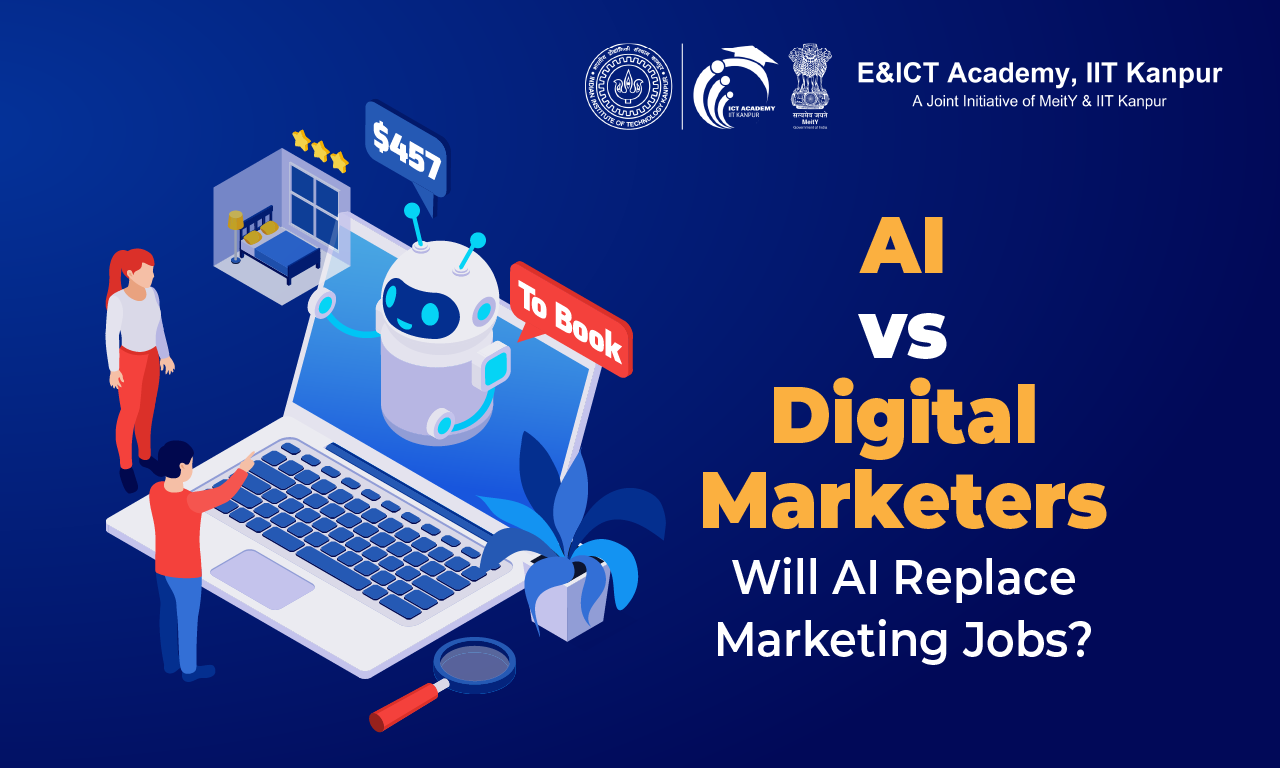
Will AI replace digital marketers in 2026? The honest answer is no. But AI will replace marketers who refuse to learn, adapt, and work with it.
AI is very good at doing tasks. It is not good at deciding which tasks matter, why they should be done, or how they connect to real business goals. That thinking layer is still where human digital marketers create their value.
Best Digital Marketing Online Course: Enroll Now!
What AI Can and Cannot Do in Digital Marketing Today
To understand the impact of AI on marketing careers, it helps to separate execution from strategy.
What AI Handles Well
- Writing first drafts of blog posts, ad copy, and email subject lines.
- Automatically adjusting Google and Meta ad bids based on performance data.
- Scheduling social media content and suggesting optimal posting times.
- Pulling analytics reports without manual spreadsheet work.
- Personalising content variations for different audience segments at scale.
What AI Still Cannot Do
- Understand what a brand truly stands for and express it consistently.
- Build trust with clients and stakeholders through real conversations.
- Decide whether a campaign idea fits the audience, timing, or culture.
- Design an integrated strategy that ties every channel back to revenue or business goals.
- Notice when data is misleading or broken and course-correct before damage is done.
In short: AI is the engine. You are the driver. In 2026, the driver is still the scarce, valuable part of that equation.
Why the Fear Around “AI Replacing Marketers” Exists
It is understandable to worry when a tool can draft a 1,000-word article in 30 seconds or test 50 ad variations overnight. It looks like the work is being done without you.
But someone still has to decide:
- What that article should say and why.
- Which ad variation actually matches the brand and the strategy.
- How to turn automated performance reports into decisions that grow the business.
AI speeds up execution. It does not replace the judgment that makes speed useful. Just like Excel didn’t remove accountants but freed them from manual calculations, AI is removing the boring parts of marketing and making strategic work more important.
How AI Is Already Changing Day-to-Day Marketing
AI’s impact is real and visible across major marketing disciplines.
Paid Advertising
Platforms like Google Performance Max and Meta Advantage+ manage bids, audiences, and creative testing automatically using thousands of signals in real time.
But marketers still:
- Choose campaign goals and budgets.
- Define target segments and exclusions.
- Evaluate whether results align with business economics, not just platform metrics.
The AI runs the engine. The marketer decides where and why it should go.
Also Read: Performance Marketing Skills
Content and SEO
Tools like ChatGPT and Jasper can generate outlines and first drafts in minutes, changing how content teams work.
Writers now spend more time on:
- Adding original insights and real examples.
- Improving structure and clarity.
- Ensuring the content matches brand voice and user intent.
The content that ranks in 2026 is not the content written the fastest. It is the content that demonstrates real expertise and solves user problems better than the alternatives.
Also Read: AI for SEO in 2026
Email and Automation
AI tools now help with segmentation, send-time optimisation, and A/B testing subject lines. They reduce the time needed to set up complex flows.
What becomes more important is understanding:
- What the audience actually cares about.
- Which messages build trust over time.
- How email fits into the broader funnel and revenue model.
Which Marketing Roles Will Change the Most?
It would not be honest to say that nothing is changing. Some roles are under pressure, while others are gaining value.
Roles Under Pressure
Jobs built almost entirely on repetitive execution are most at risk-for example:
- Manually copying platform data into reports.
- Adjusting bids all day without strategic input.
- Writing generic SEO filler content at volume.
These tasks are being automated. People in these roles need to evolve into more strategic, analytical, or creative positions rather than staying at the task-only level.
Roles Growing in Value
- Marketing strategists: who can turn business goals into integrated plans across channels.
- Data analysts: who translate dashboards into insights and decisions.
- Creative directors and brand strategists: who protect voice and generate original campaign ideas.
- AI marketing specialists: who set up, manage, and optimise AI-powered systems.
These roles rely on judgment, creativity, and communication-areas where AI is still weak.
Also Read: Scope of Digital Marketing
How to Make AI Work for You (Not Against You)
The question is not “Will AI replace me?” but “How do I use AI to become the person who cannot be replaced?”
1. Get Comfortable With AI Tools
You do not need to code, but you must learn tools already in your workflow:
- ChatGPT and Gemini for ideation and drafting.
- Looker Studio for dashboards and data visualization.
- Meta Advantage+ and Google Performance Max for paid campaigns.
Marketers who treat these tools as standard equipment are already more productive than those who ignore them.
2. Learn to Read Data Properly
AI multiplies the amount of data you have. The scarce skill is interpreting that data.
- What changed, and is it meaningful or noise?
- What does this say about customer behaviour?
- What should we do differently next based on this?
This analytical judgment is difficult to automate and takes practice to build.
3. Build Deep Expertise, Not Just Surface Skills
Shallow generalists who “do a bit of everything” are more easily replaced. Specialists with deep, hard-won knowledge are not.
Choose a lane (SEO, performance, lifecycle, content strategy, analytics, etc.), then go deep enough that your experience cannot be copied by a prompt or a tutorial.
4. Focus on Strategy, Not Just Tasks
Ask yourself regularly: “Am I only doing tasks, or am I making decisions about what should be done and why?”
The more you operate at the level of strategy and prioritisation, the safer-and more valuable-you become.
Also Read: High Paying Career in Digital Marketing
Is Digital Marketing Still Worth Pursuing as a Career in India?
Yes-if you learn it the right way. India’s digital economy is expanding rapidly, with more businesses moving online every year and needing skilled marketers to acquire and retain customers.
What has changed is the expectation. Businesses no longer want people who just schedule posts or copy-paste keywords. They want marketers who understand audience building, funnels, analytics, and how to direct AI tools towards real business outcomes.
Frequently Asked Questions
Will AI replace digital marketing jobs completely?
No. AI is replacing specific repetitive tasks, not the profession. Roles that combine strategy, creativity, relationships, and data interpretation are becoming more important.
Which digital marketing jobs are safest from AI?
Strategists, creative directors, brand managers, specialist content marketers, data analysts, client-facing roles, and AI marketing specialists are all growing in demand.
Should freshers still learn digital marketing in 2026?
Absolutely. The bar for skill has gone up, but so has demand. Freshers who learn strategy, analytics, key channels, and AI tools have strong career prospects.
Can AI do SEO better than humans?
AI can speed up keyword research, content outlines, and technical checks. But building topical authority, earning quality backlinks, and creating genuinely useful content still requires human expertise.
How can digital marketers use AI to grow their career?
Use AI to remove mechanical work (drafting, reporting, basic tests) so you can spend more time on strategy, creativity, and client communication-the parts of your job that AI cannot replace.
Final Words
AI is not the end of digital marketing. It is the end of digital marketing done on autopilot, without strategy or depth. Marketers who learn to use AI as leverage-rather than seeing it only as competition-will be the ones leading teams and shaping campaigns in the years ahead.
If you are serious about building that kind of future-proof career, focus on real projects, real data, and structured learning that teaches you both core marketing and the AI tools that now power it.